
 A few months ago I wrote about a convening built upon our primary-care depression treatment project, IMPACT, and its new umbrella center AIMS (Advancing Integrated Mental Health Solutions), led by Jurgen Unutzer at the University of Washington. I described the meeting as a “coming out party for AIMS,” which we felt had a lot to teach primary care and health systems about the value of integrated mental and general health care and the process of large-scale change. We thought these lessons would be particularly relevant to evidence-based practice in medical homes and accountable care organizations--or any health care configuration that hopes to do a better job of meeting the needs of the population.
Because this meeting was supported by a consortium including the California HealthCare Foundation, the Robert Wood Johnson Foundation, and an NIMH Conference grant, as well as the Hartford Foundation, Dr. Unutzer and his team at AIMS actually have the resources to continue developing the work started at the meeting. For once the good things that happen at a meeting won’t just end when everyone goes home.
The meeting has recently borne fruit. I want to highlight two accomplishments, both available on the AIMS website. First, from feedback and discussion at the meeting and their experience disseminating to a wide variety of health systems, AIMS has developed an important statement of principles for effective integrated mental health care.
Patient-centered Integrated Behavioral Health Care Principles
Principles of Care:
1. Patient-centered Care
Primary care and behavioral health providers collaborate effectively to provide integrated, patient-centered care. Patients have one problem list, one medication list, and one care plan that is shared by all providers, including behavioral health.
2. Population-based Care
All patients with behavioral health needs are tracked as a caseload in a registry. This prevents patients from ‘falling through the cracks’ by helping providers and practices proactively track and reach out to patients who are not following-up or not improving. The care team shares responsibility for the entire caseload of patients and psychiatric consultants provide caseload supervision, not just ad hoc consultation.
3. Measurement-based Treatment to Target
Each client’s treatment plan clearly articulates measurable clinical outcomes relevant to the behavioral health condition being treated (e.g. reduction in PHQ-9 depression score for a patient being treated for depression). The treatment plan may also include personal goals that will help both patient and provider know when treatment is making a difference in the client’s functioning. Providers assess treatment progress using an appropriate clinical outcome measure (e.g. PHQ-9) at each contact. If patients have not achieved the established clinical target after 8 – 12 weeks, primary care providers obtain mental health specialty consultation regarding treatment adjustment. Treatments are systematically and actively changed until the clinical goals are achieved.
4. Evidence-based Care
Clients are offered treatments for which there is credible research evidence to support their efficacy in treating the target condition.
5. Pay for Performance
Payers focus on value, not volume. This means that the delivery system is accountable and reimbursed for measurable quality of care, clinical outcomes, and patient satisfaction, not just the volume of care provided. Providers should be able to demonstrate that either: 1) patients are reaching the desired clinical outcomes, or 2) providers are making proactive, systematic treatment adjustments and utilizing evidence-based treatments.
While these principles were designed to bridge the artificial gulf between mental health and primary care services, I think they are essential principles for all good care. If you were to generalize them to any chronic condition, I think they hold up as the core of caring for anyone with complex needs and are therefore of particular value to older adults. The principles go a long way to address fragmentation of care and failure to follow up on predictable patient needs, and they also redirect attention to care value rather than care volume.
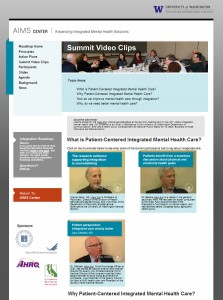
Clearly articulated health care goals are important, but so are personal stories from the leaders in a field. As part of the meeting, the AIMS team was able to get former NPR reporter Joanne Silberner to interview leaders in integrated mental health and collaborative care on video. They share clips here: http://uwaims.org/integrationroadmap/summit_video_clips.html.
I think the evidence of IMPACT and AIMS shows that we really can achieve dramatically better care. Change is possible and, even under current adverse incentives, many leading health systems have already put these lessons into practice. I look for the day when these excellent principles are applied to all care.