In Part I of this post, I shared a little about the eighth annual Hartford Interdisciplinary Communications Conference, which brings together emerging academic experts in gerontological nursing, medicine, and social work to help improve their ability to communicate about their work. After hearing “Gamblin’ Man” performed by David Honeyboy Edwards, a 94-year old blues legend at the conference, I reflected in the post that I saw gambling as a theme for the meeting.
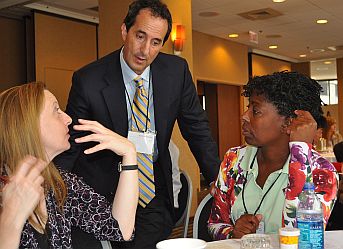
Gambling was not only a theme but also, coincidentally, the topic of two outstanding participants’ research. Fay Martin, DL, MSW, MSL, Hartford Geriatric Social Work Faculty Scholar at Wayne State University School of Social Work in Detroit, MI, was researching the effect of problem gambling on older adults’ lives and health. “Casinos are the new senior centers,” she shared with me during a presentation of her research. “This is a concern, because problem gambling is an invisible addiction that has the potential to put older adults at risk of not only mental, physical, and health issues, but also financial disaster.” Dr. Martin attended the conference so she could learn to distill the main points of her research in order to get more attention on this “invisible” problem.
Another social work faculty scholar, Kim Stansbury, PhD, MSW, of Eastern Washington University in Spokane Valley, WA, was developing similar messages based on her research theme, Attitudes and Knowledge of Older Adults toward Casinos and Disordered Gambling. However, a session on identifying and crafting messages for different audiences led her to think about ways she could convince casino operators to be more prepared to handle the potential health needs of their older players.
Not everyone, of course, was presenting gambling-related research. Lyda Arevalo-Flechas, PhD, RN, a Hartford-supported Claire M. Fagin Fellow in academic geriatric nursing at the University of Texas Health Science Center, San Antonio, TX, attended and discussed her research on family caregivers and the need for “formulation of culturally informed theory.” In other words, Dr. Arevalo-Flechas is trying to get other researchers and practitioners to think about culture and language as an important part of how they interact with older adults and their families. For example, she explained to me that talking to caregivers about their stress and burden actually creates barriers to working with many Latino family members who don’t or won’t admit to seeing their role as burdensome. She gave her research presentation an unusual title, drawing on her subjects’ perspective: Please Don’t Measure My Burden. Duty and Satisfaction are What Matter to Me.
Several junior faculty members from a number of Hartford Centers of Excellence in Geriatric Medicine also attended the meeting. Amy Kind, MD, from the University of Wisconsin shared her research examining why older adults requiring readmission after a recent hospitalization sometimes end up at a different hospital the second time around. She honed a short, to-the-point message: “Care should stay where it starts.” Michael LaMantia, MD, MPH, University of North Carolina Chapel Hill, was working on crafting a short, jargon-free message about how hospitals’ current reliance on traditional vital sign readings in the emergency department may not be the best way of predicting whether an older adult has a severe injury or illness.
This mix of scholars from different fields allowed for ample discussion about communications in the interdisciplinary teams, which are critical to advancing research and clinical care for older adults. It also gave attendees an opportunity to practice talking about their work with people outside of their particular field.
In a few months, attendees will receive a communications “booster shot”—a postcard each of them filled out—listing three things learned at the conference as well as concrete actions each expects to take to improve his or her communications. We also hope that they will spread the word about what they learned to their colleagues in the aging field (and about www.bandwidthonline.org) to help them improve their communications as well. After all, what could be more appropriate than communications lessons going viral?