 Chandelle Martel, author of "Man's Best Friend." The story took third prize in the John A. Hartford Foundation's Heroes of Geriatric Care Story Contest.
In the third and final installment of our look at the prize-winning stories from the John A. Hartford Foundation’s Heroes of Geriatric Care Story Contest, we are pleased to present Chandelle Martel’s “Man’s Best Friend.”
Her story, which took third prize, describes her work as a geriatric case manager in “turning the impossible into the possible” by developing a post-discharge plan for Arthur, an 88-year-old man with complex heart surgery rehabilitation, and his only remaining companion, his dog Charlie.
Her work exemplifies a health care process aligned with patient-centered goals and quality of life. Where other medical professionals saw on paper (and in Arthur’s symptoms) an older patient with a complicated recovery from heart surgery, Chandelle saw deeper issues, “a man who no longer had his wife, independence, health, mobility and now his dog...” which contributed to his dimming will to participate in rehabilitation.
In her words, “I wasn’t really caring for one patient, but two.” In Martel’s story, good care is not disease-specific, but rather aims to manage complex conditions and prioritize quality of life.
Man’s Best Friend
By Chandelle Martel
At 88 years of age, Arthur Wilson (not his real name) was an active and mobile resident of an Independent Senior Living Community. Always at his side were his wife and little Charlie—a Yorkshire Terrier that was more of a son than a pet. But Arthur’s life became very empty when his wife suddenly passed away.
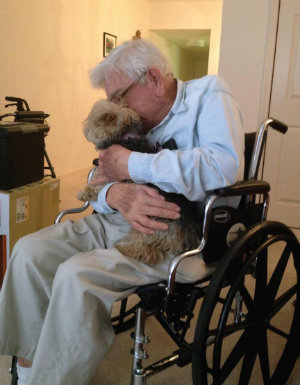 As a geriatric care manager at his senior living community, I began visiting with Arthur in his apartment to provide bereavement support. With no extended family, I knew that this man’s only companionship was a beloved, tail-wagging, 11-year-old, 9-pound Yorkie.
And his home was in Arthur’s lap.
When I got the call that Arthur had been taken by ambulance to a nearby hospital for a failing heart, I knew what others didn’t know: Arthur’s beloved terrier was alone and uncared for in that apartment.
I began doing what other medical professionals didn’t realize was a critical part of Arthur’s care: I arranged for his dog’s boarding and long-term care with a veterinarian.
With a miraculous extension on life thanks to a new pacemaker, and his overall health
improving, the doctors gave Arthur a green light and I began facilitating the discharge from the hospital to a skilled rehabilitation center. But in a matter of days after the surgery, the unthinkable happened. Arthur’s pacemaker was failing and had to be replaced. What followed was a second heart surgery and five long weeks in and out of hospitals and rehab care.
During this time, as Arthur’s geriatric care manager, I was his advocate in medical settings as many other professionals started thinking it was time for Arthur to be placed in a nursing home. I was his counselor helping him deal with despondency he felt over the loss of his independence and the loneliness from his wife’s death. And always, after I’d checked in on Arthur, I would do the same for Charlie at the vet’s office.
One day during a care plan meeting I was attending at the rehabilitation center, the staff had assessed Arthur’s progress to date and felt it would be impossible for him to function in an independent living environment due to his decline. Their solution for Arthur was a nursing home—a place I knew a dog wouldn’t be allowed to stay. What I alone saw as a geriatric care manager was a man who no longer had his wife, independence, health, and mobility, and now his dog would be gone as well. After almost nine decades of enjoying life, Arthur lost everything in less than three months.
Of course, when Arthur heard the news that a higher level of care had been recommended that required moving to a nursing home, he had just one concern: “Does this mean I can’t keep Charlie?” Arthur was distraught, weeping and losing hope because the most important thing he cared about, and what gave him a purpose in life, was about to be taken away forever. What followed was his lack of desire to continue with rehab and the staff became greatly concerned about his health. I began to visit him daily and provide support. I became a friend who gave him a measure of peace and reassurance. But I knew he needed more. I knew he needed Charlie.
Based on my geriatric training, education, and care management experience from working with hundreds of older adults every month, I felt Arthur was capable of managing his finances and making good care decisions for himself and his dog. And I knew he could handle what others hadn’t even considered as an option: a return to independent living with his dog by his side.
So, I asked Arthur if he would like for me to create a plan for his care—and Charlie’s—that allowed them both to live independently in his apartment. I never really thought I was performing a miracle, but from the smile on Arthur’s face I truly believe he thought I was turning the impossible into the possible. With this new hope I saw more life in his blue eyes than I had seen in months.
Arthur and I began to discuss things he would need assistance with for his care and that of his dog. What I set into place was far from a traditional care plan. I would arrange for private duty assistance to be given to them both. I made sure the furniture was rearranged to provide Arthur with open walkways to accommodate his now permanent need for wheelchair accessibility. In addition to creating a plan of care for Arthur’s new mobility needs, I also incorporated Charlie’s daily walks and bathroom breaks into the private duty aides’ schedules. Even medications for both Arthur and his dog had to be included into the overall care plan.
I wasn’t really caring for one patient, but two.
The rehabilitation center staff felt my care plan could work. Other medical professionals felt it could work. But I knew it would work as I put the plan into place, including transportation to meet Arthur when the rehabilitation center discharged him.
After Arthur returned to his independent living apartment, he continued to have some health concerns and spent the next four months in and out of acute health care settings. I still provided him support and offered hope that upon his recovery he would be reunited with Charlie. It was a promise that helped keep him focused and determined to recover. And that amazed everyone involved with his care. During this time I also worked with the veterinarian regarding care for Charlie.
It wasn’t until after two additional months of recovery in his apartment that I finally delivered some special, long-awaited news to Arthur. “I’m going to the vet today to get Charlie and bring him home.” I thought Arthur would be overjoyed. And I’m sure he was. But his very first response to me was, “I’m so worried Charlie will overtake you in the car.” I reassured Arthur that I felt pretty confident I could handle a 9-pound Yorkie Terrier.
Arthur was still nervous about a whole range of other issues such as whether Charlie would even remember him after seven months of being apart. But when I returned with that excited little dog, he went right to Arthur and tried to jump up to him in the wheelchair.
The dog’s stubby legs weren’t quite up to the task of making the leap, so I picked him up and reunited the two.
As Charlie licked and kissed Arthur’s face, I knew this man’s best friend was back for good.
Post script: Since Charlie’s return, Arthur’s health and happiness have improved dramatically and both are happy to be living together independently.
If you missed either of the first two installments in our look at the prize-winning stories from the John A. Hartford Foundation Heroes of Geriatric Care Story Contest, here’s your chance to catch up:
Geriatrics Expertise Saves the Day—and a Life
Caring Nurses Teach Caregiver to Speak to the Heart
You can read more about the contest and submissions from the 20 other story-telling finalists here.