Recently I got my follow-up post card that I filled out at our interdisciplinary scholars communications training held in July 2009 in Chicago. See below. If you can read my writing, you can see the lessons that I took from the training and wanted to try to implement in my work.
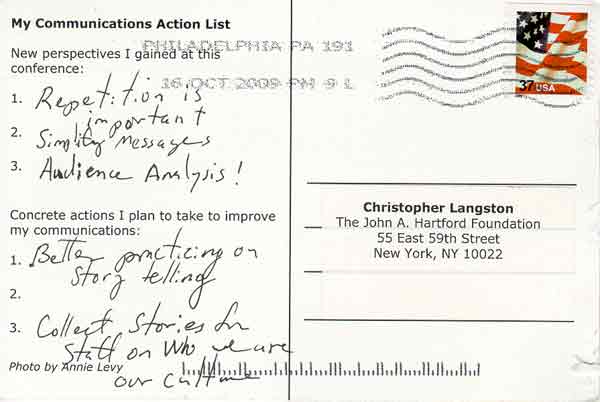
1. Repetition is important
2. Simplify messages
3. Audience analysis!
I wanted to do two things to improve my communications:
1. Better practice on story telling (sic)
2. Collect stories from staff on who we are, our culture
* * *
Today, I want to tell a story about putting these ideas into action.
Through the time-tested combination of inspiration and perspiration, Cory Rieder, the Foundation’s executive director, reached out to the office of the First Lady in the White House to suggest that as part of Mrs. Obama’s focus on families as her signature issue, she might want to give some attention to eldercare issues. Communicating with the White House, who are most certainly flooded with letters and requests, was a test of our patience and persistence. The first mailing in June 2009 elicited a form thank-you letter. The second mailing in July to the President’s office at the height of the death panel insanity received no reply.
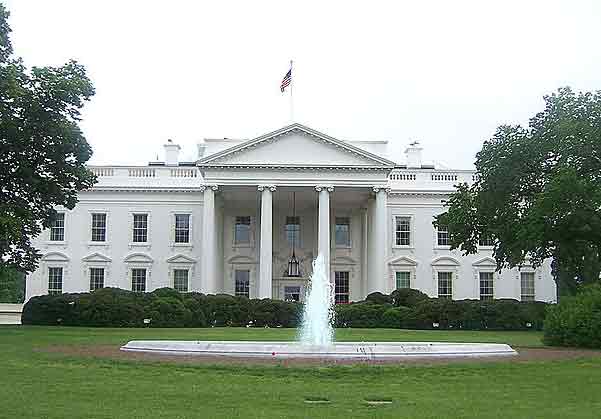 But after months of waiting, three weeks ago Cory received an e-mail from a White House staffer interested in setting up a meeting. On Monday, October 19th, Cory and I went to the White House for the meeting.
In our hands and our heads, we had the messages we’ve been polishing for years now: Older adults have a vital contribution to make to society and their families. (I got my mother-in-law taking care of my kids every day after school in as a personal story.) But to make this contribution, they need better quality health care that can only be provided by a better trained and deployed health care workforce. We talked about the Foundation’s outstanding educational and service grantees and the message that Mrs. Obama could send by making a personal appearance or site visit.
We listened as hard as we could to what the First Lady’s staff had to say about their issues and concerns.
We had our leave-behinds prepared, based on the message framework developed with John Beilenson and his team at Strategic Communications & Planning, our long-time colleagues and communications consultants. You can see the “two pager” here. At John’s suggestion we added some photographs from various projects showing older adults getting care from teams of health care professionals to illustrate our point that there are already places and programs delivering better health care to older adults. Mrs. Obama’s attention to these efforts could help the country take notice and help speed the spread of improved elder care.
The staff were polite and asked good questions. They told us a little of the First Lady’s developing priorities, and then we were on our way.
The White House is very pretty this time of year. Mrs. Obama’s office is lovely. No, we didn’t see the children, the president, or even the First Lady herself. Sometimes you have to take a chance and send your message out even if you’re unsure if you are being heard, and then wait. If need be, you have to be ready to do the whole thing again.
Please cross your fingers while we wait to see.