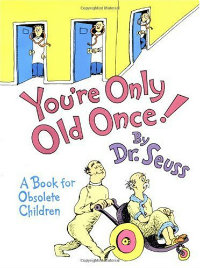
 March 2nd marked what would have been Dr. Seuss’ 109th birthday (Theodor Seuss Geisel, Born: 1904, Died: 1991). I have always been a big Seuss fan, but even more so after my 7-year-old son recently checked out Dr. Seuss’ You’re Only Old Once! A Book for Obsolete Children from his school library. (“Because you like old people, Mom.”)
It is a fantastic patient-centered read and a hilariously sad reflection of our health care system.
“This small white pill is what I munch
At breakfast and right after lunch.
I take the pill that’s Kelly green
Before each meal and in between.
These loganberry-colored pills
I take for early morning chills.
I take the pill with zebra stripes
To cure my early evening gripes.”
—From You’re Only Old Once! A Book for Obsolete Children by Dr. Seuss
The book was released in 1986 on Seuss’ 82nd birthday. It details a visit by an older man who initially entered the “Golden Years Clinic on Century Square for Spleen Readjustment and Muffler Repair” for “an Eyesight and Solvency Test.” During his visit, he is poked and prodded by more than 15 doctors (which he refers to as Oglers) and exposed to a multitude of expensive tests (e.g.,“The Diet-Devised Computerized Sniffer”) as he travels through diverse and disconnected departments (e.g., “Stethoscope Row”) that have no bearing on his health care needs.
Tragically, many of the experiences mocked in the book still hold true 27 years later and, in fact, are the focus of programs funded by the John A. Hartford Foundation. Here are some of the major themes Dr. Seuss astutely satirized, with a tip of the cat’s hat to Hartford grantees who are working to improve the system:
Excessive and unnecessary tests … : “And the next thing you know, when you’ve finished that test, is somehow you’ve lost both your necktie and vest and an Ogler is ogling your stomach and chest.”
 Hats off to Hartford’s 28 Centers of Excellence in Geriatric Medicine and eight Centers of Geriatric Nursing Excellence that are growing the leaders who create evidence-based research to improve the care provided to older adults.
And a tip of the cat’s chapeau to Hartford grantee The American Geriatrics Society, which—as part of the American Board of Internal Medicine (ABIM) Foundation’s Choosing Wisely® Campaign—created a list of five things to probably avoid to help physicians, patients, and other healthcare stakeholders address the overuse of our healthcare resources by empowering patients to choose medical tests and treatments that are supported by scientific evidence and are truly necessary for diagnosis or treatment.
… Performed by multiple specialists (e.g., the Ear Man; the Allergy Whiz; and the Footsies, Fungus, & Freckles Doctor) who make referrals, but don’t coordinate care: “Oglers have blossomed like roses in May. And silently, grimly they ogle away.”
Hats off to Hartford grantees, Dr. Kevin High and the Association of Specialty Professors team as well as the American Geriatrics Society, whose projects have increased awareness of aging issues within the specialties of medicine.
And kudos to Drs. Eric Coleman and Mary Naylor’s Transitional Care programs, which support older adults and their loved ones, enabling coordinated care across health care settings.
Despite the many doctors, there is a lack of communication with the patient:
“What those Oglers have learned they’re not ready to tell. Clinicians don’t spout their opinions pell-mell.”
Hats off to the Hartford-funded Care Management Plus and Guided Care, which empower the older patient through health technology and care plans to be a full participating member of the health care team.
And lastly, overmedication by a variety of doctors:
“The reds, which make my eyebrows strong,
I eat like popcorn all day long.
The speckled browns are what I keep
Beside my bed to help me sleep.
This long flat one is what I take
If I should die before I wake.”
Hats off to June Simmons and the team at Partners in Care, whose Hartford grant focuses on reducing medication errors in older adults.
The book was inspired by Geisel’s own series of illnesses, which frequently had him trying to navigate through the bewildering health care system. During this time, Geisel complained that he was "fed up with a social life consisting entirely of doctors."
 Perhaps not coincidentally, he begins the story by describing a paradise, a faraway land where “they live without doctors, with nary a care.” Ultimate irony: In 2012, Dartmouth’s medical school became the Audrey and Theodor Geisel School of Medicine (BTW Audrey was a nurse). Their gifts over time and estate plan make them the largest donors in Dartmouth history.
The mission of the Hartford Foundation tackles our unfortunate health care reality by supporting the health care team—the doctors, nurses, social workers, direct care workers, older adults, and their loved ones—to make change in the practice environment to improve the health of older Americans.
Happy birthday, Dr. Seuss. Given today’s broken health care system, thank goodness we are only old once.