 Knowing that the vast majority of reports, even the best of them, such as the Institute of Medicine’s Retooling for an Aging America: Building the Health Care Workforce, wind up sitting on shelves gathering dust, in 2008 The Atlantic Philanthropies and the Hartford Foundation launched the Eldercare Workforce Alliance to advocate for implementation of the IOM report’s recommendations.
As we have discussed many times in these pages, the pathway of getting the IOM recommendations (more geriatric specialists, universal competence in geriatrics, and re-engineering how care is delivered) into effect has not been straight. Early wins such as the introduction of bills by Senators Boxer and Kohl went nowhere until broader health reform made its circuitous way to passage. Since then, budget and political considerations have held up the appropriations needed to put new workforce development mechanisms into effect. And now, the struggle is to preserve funding for the long-standing parts of Title VII and VIII (the Geriatric Education Centers; the Geriatric Academic Career Awards; the Geriatric Training for Physicians, Dentists, and Behavioral/Mental Health Professionals Program; and the Comprehensive Geriatric Education Program).
 So on Thursday last week, the Eldercare Workforce Alliance put together a briefing session for senate staff to make a full court press for the value of geriatric education investments. The Alliance used its key strengths--the breadth of its coalition (family caregivers, direct care workers, nurses, and physicians) and the power of the stories of those who care for older Americans. The speakers included:
- Diana Espinosa, Deputy Associate Administrator and Director of the Office of Policy Coordination, Bureau of Health Professions at the Health Resources & Services Administration (HRSA)
- Tom Genung, Family caregiver, Hastings, NE
- Kelly Gessner, Direct-care worker, Harrisburg, PA
- Beverly Lunsford, GEC director, George Washington University School of Nursing, Associate Research Professor, Washington, DC
- David Reuben, Institute of Medicine “retooling” committee member, University of California at Los Angeles, Chief, Division of Geriatrics, Los Angeles, CA
- Moderated by: Sharon Brangman, American Geriatrics Society President, SUNY Upstate Medical University, Syracuse, NY
Two stories really struck me:
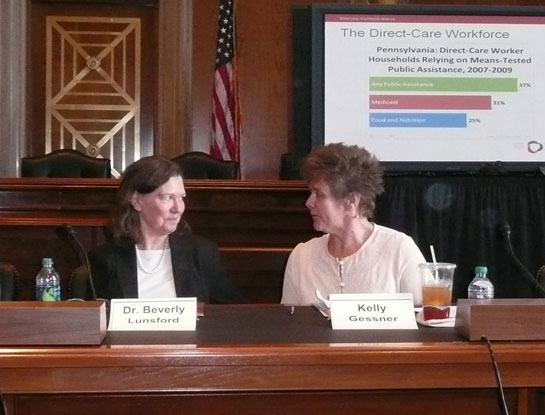
Beverly Lunsford, the director of the George Washington University–based, Washington, DC Geriatric Education Center, talked about a nurse with 30 years of experience who came to a GEC training and learned for the first time about the dangers of falls caused by bed rails. While on the surface, bedrails, like other measures to keep older adults in their hospital beds, might seem to prevent falls, in fact the evidence suggests that they do not. Instead, they make falls more dangerous if patients try to climb over the rails, and can also trap patients in gaps between the rails and mattress or entrap the head or limbs. This is a perfect example of the kind of evidence-based practice that so many health care professionals did not have a chance to learn the first time through training and have had little opportunity to pick up since. Preventing falls in the hospital is one of the ten target conditions of HHS’s $500,000,000 Partnership for Patients initiative and a long-time item on the geriatric top ten list.
Kelly Gessner, a direct care worker in Pennsylvania, talked about the meaning and fulfillment she found in helping her Medicaid long-term care clients stay at home, stay independent, and stay healthy. Far from running away from the difficulties of caregiving, Ms. Gessner, a single mother, told us how she really wanted to make direct care work her full-time job. Unfortunately, because her clients’ service hours are limited, Ms. Gressner keeps her full-time job as a welder and only works part time as a direct care worker.
These arguments and stories were so strong, I wonder if the Alliance isn’t selling itself short by just asking for level funding of the existing workforce development mechanisms. While our champions in the legislature advise us we mustn’t ask for more than level funding for fear of being laughed out of DC and embarrassing our political allies, it came to me that a better ask than maintaining the status quo would be to ask for what we really need to do the job. How can it be that the Partnership for Patients will be spending $500,000,000 over the next few years, yet there is no money for the skills training of the workforce that is vital for improving the quality and lowering the costs of care of Medicare beneficiaries? Fighting for flat funding may be the “art of the possible,” but even if we were to get it, the money will be so short that there won't even a Geriatric Education Center in every state, Geriatric Academic Career awards are open to new awardees every five years when a batch of 70 or so faculty finish their time, and most of the new workforce development mechanisms authorized in ACA will never start.
If we really believe that these mechanisms do important work, what should we be asking for? How many Geriatric Education Centers with how much capacity? How many Geriatric Academic Career awards in each eligible discipline? How many fellowship slots? What about loan forgiveness, or training for the direct care workforce? I think these are keys to successful health reform. Why doesn’t anyone in DC agree?