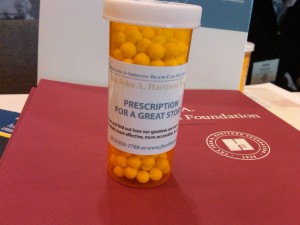
I joined Rachael Watman and other colleagues at the Association of Health Care Journalists annual conference in Chicago, where we pushed our “prescription for a great story”--the work of our grantees to improve the health of older adults. As Rachael explained in “Getting the Word Out on Geriatric Care,” this was part of efforts to improve our communications about the pressing needs and promising solutions Hartford has recognized to develop a better workforce and improve the way care is delivered to our aging population.
We talked to reporters and producers from across the country, highlighting projects like IMPACT Depression Treatment and the Medical Student Training in Aging Research program. We offered our network of grantees as resources and experts in aging issues. We listened, too. The reporters and producers I met were incredibly knowledgeable about the complex world of health care. Their deep desire to inform and empower their audiences was impressive and every one I spoke with recognized the importance of covering issues related to the health of older adults.
It was heartening to see examples of how our grantees are gaining the attention they deserve. One of the conference’s top awards went to an NPR piece, “Quality of Death – End of Life Care: Inside Out,” featuring Hartford grantee Diane Meier from the Center to Advance Palliative Care. Taking a quiet moment at the end of the conference, I read a New York Times story about the aging caregiver workforce, which prominently referenced PHI National, another Hartford-supported organization.
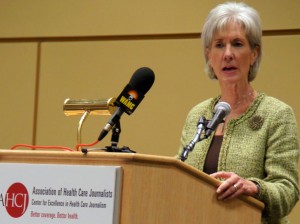
Throughout the conference, I was struck by how easy it was to point out the aging-related aspect of almost every health story a reporter told me about. The same was true for the sessions and keynote speeches presented. U.S. Secretary of Health and Human Services Kathleen Sebelius spoke about her personal experience caring for her aging mother. From panels on topics such as “Is there a Looming Doctor Shortage?” to “Addressing Racial and Ethnic Disparities,” the over-65 population was almost invariably discussed. However, as Dr. Kenneth Covinsky commented on Part 1 of this blog, I too wondered whether there was enough depth to the conversations when it came to geriatric issues.
It occurred to me that our funding strategy might be a useful analogy to what is needed in health care journalism. We fund projects to increase the number of geriatric specialists and programs to ensure that all health professions have basic competence in the care of older adults. Similarly, it may be that for health care news, reporters with specialized knowledge about geriatrics are needed along with coverage about specific geriatric workforce and delivery system issues. In addition, it seems to me that all journalists covering health care should be trained to have a basic understanding of eldercare issues, which need to be more broadly addressed throughout health care reporting.
After attending the Association of Health Care Journalists conference and seeing the interest in our work, I believe achieving this goal may be possible. In a meeting with AHCJ Board President Charles Ornstein and Executive Director Len Bruzzesse, Rachael Watman learned that aging is increasingly becoming a core component of resources offered to the AHCJ’s membership, including in workshops and training curriculum. I look forward to seeing an increase in the attention paid to aging issues by radio, print, television, and Web journalists. And I look forward to seeing the incredible work of our grantees in the news so that the public can indeed read all about it.