Shortly after I joined the Foundation, I started working on an effort to deliver effective continuing education in geriatric issues for generalist physicians interested in improving their care of older patients. The project, which was known as PPE--Practicing Physician Education--was very successful by all internal criteria. We created a low-cost, train-the-trainer infrastructure married to the membership and support of the American Academy of Family Physicians and the American College of Physicians. Unfortunately, between the development of the training model/materials and the effort to create sustained takeover of the project by the primary care societies, we had a series of miscommunications and misaligned expectations that derailed the project.
 However, one small part of the project, really an afterthought, has survived and grown over the years since 1998 and has just celebrated its 14th birthday. Out of a $1.9 million grant to the American Geriatrics Society (AGS) under Patricia Barry, former AGS president, we gave around $100,000 to provide late-stage financing for the first edition of Geriatrics at Your Fingertips, which AGS had started but lacked the funding to complete.
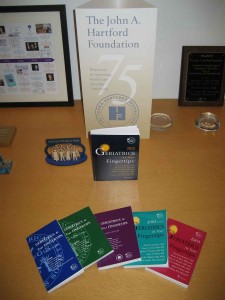
The little blue copy on the far left is the original 1998/1999 edition. The idea was to have something really small that would fit in a medical coat pocket so practitioners could step out into the hall for a quick check of dosing, an assessment tool, or a diagnostic algorithm. Then, as now, we wanted to help all health professionals provide better care to their older adult patients, and the idea of a well-indexed geriatric consult in a provider's pocket was very attractive.
Given how great GAYF (as it became known among us insiders) looked, we were happy to build it into a couple of other projects. By 2000 we bought some 16,000 copies for distribution to all rising third-year medical students as they hit the wards for the beginning of their clinical training. At that point our medical student education project through the Association of American Medical Colleges was getting into full swing, which gave us an easy way of directing the resource to medical students; the association had connections to deans of education at medical schools all over North America. Of course, the reception was mixed. Some schools highly valued GAYF, and we even got direct requests to buy copies off and on for years afterwards, but we heard at other schools the dean was using his or her box of GAYF as a doorstop (perhaps some still are).
I can’t recall how many years we did bulk distribution, but we were very happy to support the printing runs of the guide and to help create a market for GAYF after our subsidies ended. Today, while PPE is a fading memory eclipsed by more advanced practice redesign efforts like ACOVE (Assessing Care of Vulnerable Elders) and approaches based on maintenance of certification/quality improvement, GAYF is continuing strong. It is AGS’s highest selling product, with almost 14,000 units shipped in 2012. In addition to transforming into a fashion-friendly, slightly larger, black book, it has migrated into online and mobile versions available for Apple, Blackberry, and Android platforms: see www.geriatricsatyourfingertips.org. Schools can buy site licenses for trainees.
While we don't have formal evaluation evidence, given the practical and pragmatic orientation of the guide, I think it very likely that GAYF is helping practitioners and future practitioners improve their care of older people. This year’s edition even has a new section on the Medicare Annual Wellness Visit. Now we just need to get patients to actually use their Wellness Visit.