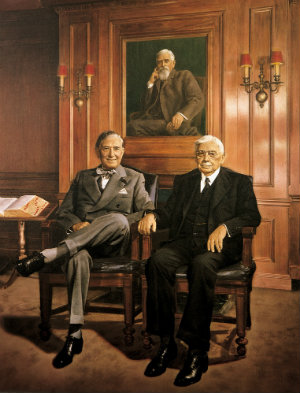
 John A. Hartford, left, and George L. Hartford pose for their portrait circa 1950. The portrait behind them is of their father and A&P founder George Huntington Hartford.
The John A. Hartford Foundation, known more simply as the Hartford Foundation, frequently gets associated with a certain city in Connecticut or a certain insurance company (picture antlers). Given the birthday of the Foundation’s namesake this week, we wanted to take a moment to share a bit about our origins and history. We want to celebrate the man and his family whose fortune from the A&P grocery company has been working toward the “greatest good” for 84 years.
John Augustine Hartford was born on Feb. 10, 1872, the fourth of five children of George Huntington Hartford and Marie Josephine Ludlam. In the early 1900s, John and his oldest brother, George L. Hartford, took control over the company their father helped found and run, the Great Atlantic & Pacific Tea Company. The company began as a mail-order tea business and grew into the retail grocery empire commonly known as the A&P. By 1929, the company had surpassed $1 billion in annual sales (becoming larger than Sears Roebuck & Co.), with 15,000 stores and five million customers daily.
It was also in 1929 (April 1st to be exact) when the heirless John A. Hartford, a millionaire thanks to the A&P, decided to give formal structure to his already well-established philanthropy by setting up a foundation in his name. Upon his death in 1951 and a bequest of cash and A&P stock, the Hartford Foundation had an endowment valued at roughly $55 million. By 1959, two years after the death of the also childless George L. Hartford and the settling of his estate, the Foundation was valued at more than $325 million, making it the fourth largest in the country. (Even though he was the larger benefactor, George expressed no desire to add his name to the foundation.)
Just as the A&P revolutionized the retail grocery industry, the Hartford Foundation in its early days helped catalyze revolutionary advancements in health care, and became known for supporting pioneering work in medical technology and biomedical research. By the 1950s the Foundation had become the largest private, not-for-profit supporter of clinical research in the U.S. The Foundation supported remarkable ahead-of-its time work in areas such as kidney transplants and dialysis, cardiac care and the development of the artificial heart, burns and microsurgery, and cryogenic techniques. Hospitals were funded to study the use of cutting-edge medical technology.
However, all of those efforts were supported based on the natural interests of the founders expressed during their lifetimes, and not on any official mandate. The Foundation’s 1958 annual report gives this testament:
“Neither John Hartford nor his brother George, in their bequests to the Foundation, expressed any wish as to how the funds they provided should be used … Our benefactors’ one common request was that the Foundation strive always to do the greatest good for the greatest number.”
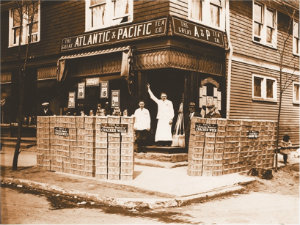 By the end of the 1920s, the Great Atlantic and Pacific Tea Company had 15,000 stores and more than $1 billion in annual sales.
Health care and biomedical research, however, was clearly of interest to the Hartfords and could certainly be viewed as ways of accomplishing this “greatest good, ” a phrase that gave Judith Jacobson the title for her history of the Foundation (you can download free PDFs of the book’s Introduction and Chapter 1). In addition to learning about the Foundation’s grantmaking from the 1950s to late ’70s, tidbits of fascinating trivia can be found throughout. (Did you know that for two weeks in 1942 the Foundation was officially reorganized and renamed the Buena Vista Farms Foundation, after Hartford family property in Westchester County? No record exists of the reason for the change or why it was so quickly reversed, but it’s fun to imagine us as the BVF Foundation.)
The Greatest Good also gives us an understanding of why, in the 1980s, the Hartford Foundation Trustees focused its work even more narrowly within the health care sphere. Along with the mandate of doing the greatest good, the founders left this piece of advice:
If available funds are to be used effectively, it is necessary to carve from the whole vast spectrum of human needs one small band that the heart and mind together tell you is the area in which you can make your best contribution.
The Trustees took this advice to heart and in the 1970s shifted out of general biomedical research. First, the Foundation focused on improving the quality and cost effectiveness of healthcare and then from 1982 on, became increasingly focused on improving health care for the coming wave of older adults. Since 1995, the Foundation has determined that its best contribution can be made by putting all of its resources toward a single purpose—helping ensure that older adults in the U.S. receive the best, highest quality health care possible.
Thanks to the generous bequests of its founding donors, the Foundation -- now independent of the family and the company -- has awarded more than $450 million in grants in its Aging and Health portfolio, transforming the education and training of health professionals and helping to redesign health care delivery to meet the needs of our aging population.
As we celebrate John A. Hartford’s birthday this week, we acknowledge the pioneering, philanthropic spirit of both him and his brother George. We hope to continue as good stewards of the resources and mission set out for us: to do the greatest good in the area where we can make our best contribution.