A few weeks ago, I gave some preliminary reactions to the passage of health reform from the perspective of advancing the foundation’s mission of improving health care for older adults. I tried to cover the good things and the bad, in two posts – glass half full and glass half empty. Having had a little more time to digest and think and get some feedback on the legislation, I want to offer a bigger perspective.
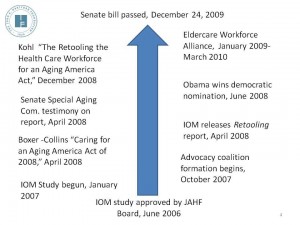 Here you can find a PowerPoint presentation that covers how we at the foundation see the history, issues, and some details about what we wound up with in the reform bill. I have shared this with a number of people more expert than I and sought all the feedback I can get. Unfortunately, I have gotten very little, which means that it is virtually certain that I am mistaken about some of the interpretations in the PowerPoint. Here are a few things that I have learned:
- The amounts of money mentioned in the legislation are just suggestions – the appropriations process will make the money real, and only a wide range of subsequent agency and administrative actions will ensure actual spending. I have heard various opinions about the value of the sums of money included: that they set floors, ceilings, or are just irrelevant. Some people argue that having the dollar figure specified is a good thing; others contend that it is just an anchor dragging our efforts down.
- The demonstration projects described in the legislation are only suggestions to the secretary. People who were in a position to know say that if the demonstrations were truly required, the Congressional Budget Office would have “scored” the legislation (i.e., calculated its financial impact) significantly more negatively.
- I misread the provisions of Section 5305 of Title V that provide for additional funding to Geriatric Education Centers (GECs). I had thought that the section was funding new additional GECs, 24 of them at a terribly low rate of $150,000 a year each. However, Nancy Lundebjerg of the AGS recently corrected my error; these are intended to be 24 supplemental awards of up to $150,000 for about half the existing GECs. The funding is to help them take on new work in faculty retraining, plus a choice of either educating family caregivers and direct care workers OR educating for best practices in geriatric care. This makes much more sense given the suggested resources and is a very worthwhile strategy as the Reynolds FD-AGE sites and our Nursing GNEC, FLAG, and Social Work Gero-Ed Center programs have shown.
I do hope that readers will offer further corrections and clarifications. My notion of how the aging/geriatrics community should approach the advocacy effort around health care reform has always been stone soup – while nobody individually has all the resources or expertise needed to get the job done, if we all pool what we have, we will be able to get there. The job is not done by any means (see this recent Atul Gawande article in the New Yorker for more information on the obstacles that lie ahead. Implementation is key and fraught with difficulty; this includes appropriations, assignment of tasks to agencies, demonstration design, rule making, grant making, etc. We have seen again and again good ideas deformed beyond recognition in this process, results withheld or buried in deference to political or commercial concerns, and a general lack of capacity and attention getting in the way of changes in the health care delivery system.
Happily, President Obama recently nominated Don Berwick, MD, to head CMS. We need him confirmed with a clear mandate to use CMS’s tools to change how the health care system interacts with its users; i.e., what happens (and does not) between patients and providers to be sure that health care delivers the value we all desire.