
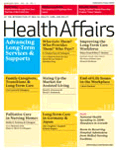
Not only did the new SCAN Foundation sponsored series, "Caring for the Aging Patient: From Evidence to Action" start late last month in The Journal of the American Medical Association, but on Tuesday January 5, 2010, the SCAN-sponsored special issue of Health Affairs, "Advancing Long-Term Services and Supports" was released at a special briefing session at the National Press Club in Washington DC.
 SCAN President and CEO, Bruce Chernof, MD kicked off the event with observations about the importance of thinking through the full continuum of long-term care needs of older adults (and the disabled) and the willingness of the policy-analytic community represented by Health Affairs to address the issue.
Among the important papers in the issue, Vince Mor and colleagues from Brown and Harvard provide another look at the issue of hospital readmissions recently reignited by the April New England Journal of Medicine paper by Jencks, Williams, and Coleman . Mor et al. found that in 2006 almost 25% of Medicare beneficiaries discharged from the hospital to a skilled nursing facility (SNF) were readmitted to the hospital within 30 days. Given that Jencks, Williams, and Coleman found that 19.6% of beneficiaries discharged to all settings were readmitted within 30 days (in 2003-2004), I think there is something seriously wrong with this picture.
Even if sicker patients are discharged to SNFs as compared to those discharged with home health care or just plain home, given the greater resources that are supposed to be deployed in this organized setting of care, I can't accept that the readmission rate should be higher! Either these patients should not be discharged at all or they are receiving inadequate care in the nursing homes that are being paid the Medicare rate for post-acute skilled care. Of course, for nearly all of these readmissions, the hospital is then paid for another episode of care. The authors estimate that Medicare paid more than $4 billion for readmissions from SNFs in 2006. When I try to explain this to average citizens, I am often asked if I also market perpetual motion machines or want to deposit some money from a Nigerian bank in their accounts.
Clearly there are major opportunities to improve the quality of care and control Medicare spending through some of the mechanisms proposed in the pending health care reform legislation--such as bundled payments or accountable care organizations. A meeting later in January to be held at the Brookings Institution and co-sponsored by Hartford and SCAN will look specifically at the role of long-term care and community provider organizations in Medicare pilot projects and the need to consider the special needs of older adults in the redesign of the health care system. Watch this space for news.