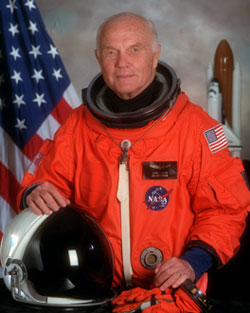
It was a pleasant coincidence that I found myself at the Kennedy Space Station the same day they were celebrating the 50th Anniversary of Senator/Astronaut John Glenn’s orbit around the earth. I hadn’t seen Senator Glenn since I worked at the International Longevity Center, where he was a member of the board. But seeing him at 90 years old on the stage speaking so humbly yet with such command, I was immediately transported back in time to 1998, when he was being considered for the mission of the Space Shuttle Discovery.
Many people said he was too old, at age 77, and it was too dangerous to send him into space. I was working with Dr. Robert Butler, President and CEO of the International Longevity Center, at that time, and he was on the advisory medical team overseeing Senator Glenn’s health before and after the shuttle’s mission. Dr. Butler was quoted in the January 16, 1998, NASA press release: "It serves both science and a better understanding of what human beings of all ages will experience as we enter the next century to have an older person included on a space flight," said Butler, one of the nation's foremost gerontologists. He continued,
Senator Glenn is particularly well qualified since he has done this before, and because of his work with NASA and the National Institute on Aging to develop research that will lead to a better understanding of the effects of aging. His involvement makes a bold statement about the capabilities of older people and will help us understand the effects of aging and space flight. Senator Glenn's courage and willingness to undertake this mission are notable.
I remember being thrilled and a bit worried (despite myself) about Senator Glenn’s mission. How would he fare? Would his health, bone density, or equilibrium be altered temporarily, or even permanently? It was such a relief when he landed and was found to be healthy in all ways. In fact, on the stage in Orlando a few weeks ago, he appeared healthier than the others with him. He hadn’t changed much since I had last seen him in 2004.
In the opening of his remarks at that celebration he made references to his age and told a few ageist jokes. I suppose he was trying to put us all at ease, because certainly at 90 years old he is really and truly old. In fact, he is the only astronaut who has been able to celebrate his 50-year anniversary of his first space flight. But other than his chronological age, and being a bit slower than I remembered him to be, he seemed to have no disabilities. He spoke without notes, with a firm loud voice, and was completely captivating.
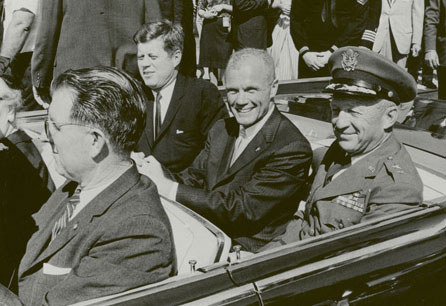
John Glenn continues to break barriers; he did so 50 years ago and 15 years ago, and he did it again on February 18, 2012, with his command performance at the anniversary celebration. We at the John A. Hartford Foundation often discuss how to best change the perceptions of aging in order to have healthcare professionals and policy makers interested in providing better quality care to older people. John Glenn still “makes a bold statement about the capabilities of older people” and is living proof that the perception that medical care of older people is a futile waste of time is just wrong.
Author Tom Wolfe has called John Glenn “the last true national hero America has ever had.” As a nation during the Cold War, we needed to believe that our nation was great and capable of doing anything. John Glenn’s first orbit in space provided that. As our nation ages and our health care system continues to unravel, we need another visionary like President Kennedy to inspire us to dream of “reaching the moon”–in this case, building a better health care delivery system for our older citizens. We also need a hero like John Glenn to help us believe that it is possible. In a New York Times article published February 13, 2012, John Noble Wilford wrote, “In a time short of heroes, John Glenn keeps alive the memory.” That is the memory that we can achieve anything we, as a country, decide to do. We’ve been to the moon. Now, let’s decide to improve health care for our older citizens.
Thank you, Senator Glenn, for all you have done for our country.