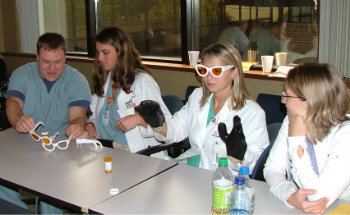
 Trainees take part in an opening exercise at a CRIT retreat at the University of South Carolina in Columbia to experience what it's like for older Americans with eyesight problems and arthritis.
In the world of primetime TV, the role of a hospital’s chief resident only seems to pop up as a plot device to create conflict. On the comedy Scrubs, on-again, off-again couple J.D. and Elliott were pitted against each other by Dr. Cox as co-chief residents for a season. On the drama Grey’s Anatomy, the question of who would be named chief resident fueled fierce speculation and heated debate on fan sites a couple of seasons ago.
But those of us who work in health care understand the enormous impact and influence that chief residents have in real life. Chief residents are the leaders among their peers, entrusted with administrative and teaching responsibilities within their training program. They supervise and train junior residents and medical students; develop schedules for rotations, conferences, journal clubs, lectures, and on call coverage; they serve as a liaison between faculty and residents, and hospital staff; they teach medical students and reassign residents as needed; and they communicate directly with patients and their families.
 Trainees are focused during a classroom mini-lecture during a Boston Medical Center retreat.
So if you want to infuse geriatrics principles into training programs for doctors and faculty, reaching out to chief residents is a great place to start. That was the idea behind the Chief Resident Immersion Training Program (CRIT), which was developed by Sharon Levine, MD, professor of medicine at Boston University School of Medicine, originally funded by the Donald W. Reynolds Foundation and pioneered at Boston Medical Center. Based on its success, the CRIT model became a national demonstration, funded by the John A. Hartford Foundation for the past four years and in collaboration with the Association of Directors of Geriatric Academic Programs (ADGAP). During that time, the CRIT program reached 295 chief residents representing 29 specialties. The chief residents participated in two-and-a-half day immersive retreats, which were held at 12 supported institutions.
The retreats, which also included faculty, focused on:
- Incorporating geriatrics principles into chief resident teaching and administrative roles
- Developing chief resident teaching and leadership skills with a focus on the care of complex older patients
- Enhancing leadership and teaching skills that are necessary for a successful term as chief resident
- Enhancing chief residents' abilities to collaborate with other disciplines in the management of complex older patients
- Developing an "achievable" project for chief residents focused on a geriatrics issue that can be carried out during their chief residency year
 A trainee asks a question during the CRIT retreat at the University of South Carolina.
Most encouraging is that 89 percent of the chief residents participating in the retreats went on to institute action projects.
The Hartford grant is now over, but the program has a bright future. To help with the transition, we sponsored a meeting with past and current CRIT program leaders and faculty focused on long-term sustainability, and we helped support the development of a CRIT sustainability tool kit that will be posted on the ADGAP website (a sample of the toolkit can be viewed here.)
Three of the 12 institutions funded by the Hartford Foundation have secured additional funding and are continuing to train chief residents. And the Hearst Foundations have stepped in to provide funding that will enable ADGAP and Boston Medical Center to expand the CRIT model to an additional 19 institutions; already, 11 of the 19 have been implemented. The Reynolds Foundation also has contributed funding to Boston Medical Center to support an additional six CRIT programs—three of which have already been established. By 2014, there will have been CRITs in 40 institutions nationwide training more than 1,000 chief residents.
Edmund "Ed" Duthie, MD, professor of medicine and chief of the division of geriatrics/gerontology at the Medical College of Wisconsin, experienced firsthand the difference that CRIT training makes.
“On Christmas Day 2009, I learned that one of my patients was bleeding from his tracheostomy,” Duthie later recalled.
Fortunately, the chief resident on call from Ear, Nose and Throat had worked with Duthie in the CRIT program earlier that year.
“I believe that this familiarity, that otherwise would not have occurred without CRIT, resulted in the chief’s dispatching a junior resident to promptly see the patient on a holiday and solve the problem” Duthie wrote in a letter to the Hartford Foundation. “I fear that without the CRIT, we would have been left with the usual communication problems and poor attitudes toward frail institutionalized patients that frequently occurs in large academic centers. The patient had a good outcome.”
And the evaluations submitted by participating chief residents echo the positive impacts the program has had.
“CRIT was a wonderful experience,” one wrote. “Not only was the education that I received invaluable but the network opportunities that were created among the other specialties helped
throughout the year with difficult cases that were co-managed.”
We are proud to have supported this valuable program, and are extremely pleased to see it make a successful transition to a sustainable model. The chief residents who successfully completed CRIT—along with those now going through the program as well as those who will benefit from it in the future—will make a real difference in the quality of care for older adults.