
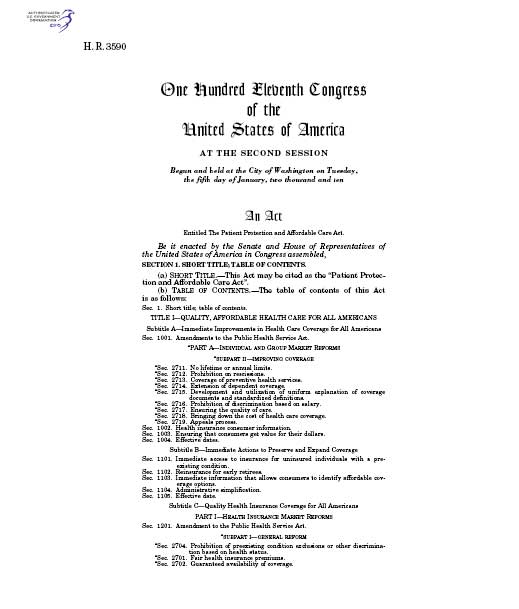
 The Patient Protection and Affordable Care Act (PPACA, or ACA as we insiders call it for short) has some very aggressive timelines. Among them is the new Center for Medicare and Medicaid Innovation (CMI) to be up and running by January 2011.
One of the top priorities of many health policy wonks and particularly Drs. Mark McClellan (former CMS director, now director of the Brookings Institution’s Engelberg Center for Health Care Reform) and Elliott Fisher, director of Dartmouth’s Center for Health Policy Research, is the Accountable Care Organization. Putting together Dr. Fisher’s observations from the Dartmouth Atlas that local variations in health care utilization do not seem to be related to patient needs or outcomes, but rather determined by local provider culture, the Accountable Care Organization is an intervention intended to make physicians and hospitals jointly interested in reducing utilization while maintaining quality and satisfaction. Based on the experience with the current Physician Group Practice Demonstration program (PGPD), begun under Dr. McClellan’s tenure at CMS, the ACO stands to share in savings from reductions in overall utilization, thus arguably giving a physician-hospital collective a joint incentive to reign in dubious practices such as high rates of MRIs or surgery. (In fact, in PPACA the provision specifying an ACO pilot is actually called the Medicare Shared Savings Demonstration.)
Given the high level of political agreement around this priority, CMS is trying to get started on the ACO planning right now. Before Dr. Berwick’s recess appointment, it held an “Open Forum Call on the ACO” on June 24 to get feedback from stakeholders on the concept. Since I spent the two hours on the call, I can give you the gist of it and save you some time.

First off, CMS was not actually answering any questions. When asked questions, they reminded me of exam proctors from my student days. They said that all they could say was what was in the legislation and that they could not provide any further information. I kept thinking they were going to repeat the classic SAT advice of going with your first impulse.
Given that there were not going to be any useful answers, that left the call entirely over to “public” comment from the attendees. The American Hospital Association was the first speaker. I believe they called for attention to private sector models, incrementalism, and no public release of quality data until “later.” Basically, in all ways they cried, “Mercy, mercy!”
There was a very nice coordinated effort made by many of the consumer organizations participating in the Campaign for Better Care, each using a common message, acknowledging their membership in the Campaign, and hitting various topics of consumer concern--such as volunteerism and regulations to prevent patient cherry-picking and discrimination/dumping.
There was a big flurry of excitement as the American Medical Association’s chief lobbyist was supposedly coming to the phone, but alas we heard only from an associate. Not unexpectedly, the AMA wants to be sure that the ACO is safe for physicians--that it be structured to allow the participation of small office practices and that quality measurement start out with process rather than health outcome indicators. There was even a real “doc in the street” from Miami who observed that in many ways the ACO was managed care redux. He warned that there was little reason to believe that it would wind up better than the first time, as long as for-profit entities were still involved.
For my part, I waited in the queue to make a comment, but never got called, and for the life of me I can’t find the promised mechanism for delivering written comments. So, here’s what I would have said:
Despite all of the two hours of comments and the debate around the ACO idea and even the experience of the PGPD, there seems to be remarkably little attention to a few key facts. The ACO design needs to keep in mind that the highest utilizing and most expensive beneficiaries--who are also those who can most benefit from more coordinated care and help the taxpayers save money--are those multiply chronically ill Medicare beneficiaries, usually quite elderly. These patients are frail, complex, and multimorbid, with high rates of cognitive and functional impairments. Their care is the special concern of geriatric specialists, who need to be intimately involved in planning and implementing demonstrations such as this one.
Because of the complex needs of the chronically ill older adult population, ACOs need to ensure the participation of the full range of service providers, including home health, nursing and rehab facilities, and social service agencies in addition to hospitals and physicians. Moreover, older adults who are residents in long-term care facilities and programs must not be excluded from the demonstration/pilot, as they are also high utilizers and often receive low quality health care services.
Because of the nature of this population, quality measures need to give priority to beneficiary day-to-day functioning, quality of life, and quality of death more than a more narrow technical focus on individual disease process and outcomes.
And finally, professionals specially skilled in geriatric care as well as arranging social support and services for older adults are essential as advisors, technical assistance providers, and care coordinators. For more on this topic, see also this post in the Health Affairs blog.
I am glad that CMS is taking ACOs seriously. But if we mistakenly believe that by virtue of shifting financial incentives alone an ACO can be successful in the Medicare population as easily as some cost-curve-bending interventions have been in the Medicaid and commercially insured populations, this demonstration will fail and we will all be very sorry.
Resources from the Center for Medicare and Medicaid Services:
FAQ
Open Door Forums