
 Last week, Chris Langston wrote that the words “long-term care” are the three scariest in aging. “Many people will tell you they would rather die than go to a nursing home,” he continued. Yet, as Cory Rieder wrote in 2009, often long-term care may be the right choice for many individuals. In the case of my Uncle John, about whom I wrote in November, he experienced more happiness in the last year of his life, spent in a nursing home, than I ever could have hoped.
Not all nursing homes are created equal, of course. As with any services for older people there are good and there are poor facilities. In my days as an eldercare consultant I recommended that families seeking a long-term care facility for their older relative choose a facility close to them so they could visit on a regular basis and monitor the care. Additionally, now there are long-term care facilities that practice culture change–patient-centered care, which allows the residents to exercise their independence by making as many of their own choices as possible.
Thankfully, the nursing home in which I was able to place my Uncle John, Isabella Geriatric Center in Washington Heights, Manhattan, NY, was within walking distance of my apartment. I selected Isabella not only because it was close to me, but also because I knew the director of social services there. She had been a member of a group of geriatric social workers who met several times a year to discuss issues related to providing the best care for older people, both within an institution and in the community. I knew that the social workers under her supervision were trained in providing geriatric care. Also, the administration of Isabella were committed to culture change and were working with PHI for continued improvement via PHI’s Coaching Approach. Uncle John suffered from mild cognitive impairment, several chronic diseases, and was confined to a wheelchair. Yet at Isabella he could choose the the type of meals he preferred as well as when he wanted to eat them. The meals were served in café style, and the dining room, on his floor, was decorated as much like a home environment as possible. Uncle John could also use the grounds for smoking a cigar, and at the weekly cocktail hour he could have a beer.
In addition to the amenities that allowed Uncle John to have a sense of independence, Isabella offered many activities for the residents. Uncle John was not interested in learning about computers or attending the book club. He did, however, love to put model ships together, so staff encouraged him to attend the art classes. He loved drawing, and staff hung his artwork around his room. But he really loved the pottery class and didn’t miss one class.
Isabella was not merely excellent at keeping residents entertained. They also provided excellent care. I was invited to Uncle John’s care plan meetings, which I attended when I could. With Uncle John present, we discussed all aspects of his care, from his physical therapy, to nutrition, and also his medicines. The staff kept me apprised of any medical changes and changes in his medicine.
Isabella was a significant improvement for Uncle John. He came there from an assisted living facility in the Pocono mountains in Pennsylvania, near his previous home where he had lived for years with my aunt before her death. His health deteriorated there, where he lived in isolation, visited by no one except me. When he was first admitted to Isabella, he cried often. A psychiatrist saw him and prescribed anti-depressants as well as weekly psychotherapy sessions. Dr. Whelan, a psychologist, met with Uncle John each week. Dr. Whelan monitored my uncle’s response to the anti-depressants, and as the doctor tweaked Uncle John’s meds and as the weekly psychotherapy sessions progressed, Uncle John’s mood and affect changed for the positive. I noticed that he began experiencing pleasure and was not as obstinate, angry, and resistant. Uncle John began developing friendships with the staff and with some residents, and he proudly displayed his sculptures and artwork. In fact, he was happier than I had seen him in a long time. Prior to my aunt’s death, they lived in a trailer home in the mountains. They were far from family and had become more and more isolated from friends due to John’s inability to walk. Now Uncle John had friends he looked forward to seeing every day, and I would soon discover they enjoyed him too.
While at Isabella, Uncle John made frequent trips to the hospital for urinary tract infections, one of which resulted in the disastrous discharge I wrote about in November. A year or so after he returned to Isabella after a brief stay at a less patient-centered facility, Uncle John was again admitted to the hospital for yet another urinary tract infection. But this time it was different. Uncle John was having trouble breathing, and there was a blockage in his colon. As his health care proxy, I was asked if he should be intubated. Fortunately, Uncle John and I had discussed such things, and according to his wishes I declined. When he was able to speak for himself he verified the decision. He was admitted to the ICU and two days later he died.
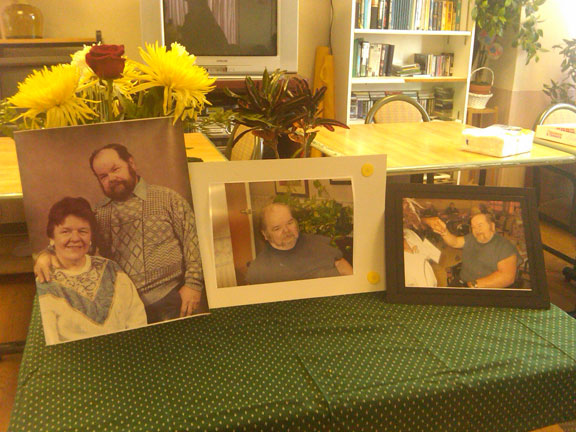
I was surprised by the reception when I went to Uncle John’s room at Isabella to collect his belongings. Many staff and residents stopped me to express their sadness over losing their friend. The security guards told me that John visited them every day; several young women in marketing told me he also visited them daily and that they had gone to the hospital to see him. A couple weeks later I received a call from the social worker. She said that since so many staff and residents were grieving, they decided to hold a memorial service for John (usually one is held twice a year  for residents). They invited me to attend. The minister was there, and staff set up pictures of John on a table with flowers. The head of marketing put together a slide show of photos of John with staff and residents and in his pottery class. The pottery instructor also designed a glass display of his artwork. Many residents and staff attended the memorial service, and several people spoke of their fondness for John and told stories about his antics. I was so surprised and very pleased that in the last year of my uncle’s life he had found new friends and discovered a new hobby, while receiving good quality nursing care.
If Uncle John had not been in Isabella, he would have died a lonely and depressed man. I am very grateful for the care Uncle John received from Isabella. And I am grateful that there are nursing homes that practice patient-centered care and have staff who are well-trained to care for geriatric residents. Now we need to find a way to convince other facilities to do the same.