 Ever since I began working as a program officer at the John A. Hartford Foundation, I’ve tried to do my best to put myself in the shoes of the health professionals with whom we’ve worked and whose education and training historically has been one of our main concerns.
I’ve often found memoirs and other lightly fictionalized accounts to be the best way to get into the culture and daily experience of these health professionals. I’ve read Samuel Shem’s The House of God, countless memoirs of nurses and physicians, and even a very affecting memoir of a nurse’s aide in a nursing home.
One of the tricks of such reading is that we experience what our imagination and the author’s words together conjure in a special state of willing suspension of disbelief. Psychological research suggests that this process of imagination and purposeful lowering of critical skepticism is, in fact, what makes fiction so persuasive and engenders the feeling that novelists understand a truth about human character that other ways of knowing can’t match.
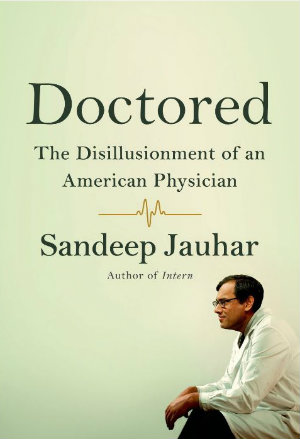
Consequently, for the past week I’ve felt vicariously quite depressed as I’ve been reading Doctored: The Disillusionment of an American Physician by Sandeep Jauhar, a cardiologist working for Northshore Long Island Jewish Medical Center. Dr. Jauhar, in this his second memoir, recounts his first five years of professional practice after concluding his cardiology fellowship in one of the academic health centers of Manhattan. He struggles with the costs of his medical student debt, a long commute, the demands of caring for his young children, and clearly feels anxiety and depression as he struggles with his professional and personal identity.
However, despite an occasional concern about the limits of his professional knowledge, the major source of Dr. Jauhar’s professional distress has to do with the conflict between his professional ideals and the ugly realities of modern health care. Needing to get along in the hospital culture, to earn additional income beyond his salary (and meet productivity requirements), and yet feeling disgusted by some of the unethical “just business” shenanigans that go on around him, he experiences all of the burn out, stress, and disillusionment implied by his subtitle.
For his mostly older patients (he specializes in the treatment of heart failure—a a final common pathway for the effects of age and chronic disease), this conflict often results in unnecessary testing, hospitalizations, and care that is at odds with patient and family wishes. He describes a subculture of shady referrals, spurious testing, and “consultitis”—physician back-scratching to enable wealthy doctors to afford the lifestyle to which they would like to become accustomed, long after the “party” of loose money in health care has ended.
Of course, patients and families often continue with self-destructive behaviors and harbor unrealistic expectations and demands for services that cause them to collude in bad outcomes at terribly high costs. And managed care companies seem to invite an arms race of gamesmanship by their own unethical practices of unreturned phone calls, arbitrary denials, and “forgotten” payments.
I found this book terribly bleak and thought that the slightly positive ending, where Dr. Jauhar’s conflicts and professional despair are resolved by moving to the suburbs, shortening his commute and lowering his living expenses, infuriating. But one conclusion I take from this personal description of the conflicts, as well as the moral and morale crisis they produce in modern medicine, is that the “crisis” is one of alignment, where what is good for physicians (and their families) is too often and too directly pitted against what is good for payers, patients, and society in general. The resulting conflict breeds a false consciousness that erodes trust, candor, and the spirit.
As many experts in health policy have observed, there isn’t one thing that we need to do to fix our cost and quality problems. There are many solutions, each of which makes up a small slice of the total solution. We will need to invest more in prevention to avert bad health outcomes (both financial investment and changes to our lifestyles.) We will need to reshape the health care workforce and make it easier to get comprehensive primary care with expertise in aging and chronic disease to reduce our dependence upon specialists. And we will have to be evidence-based about what professional can deliver what kinds of care most efficiently, rather than be at the mercy of guild politics.
At the end of the day, we will need to spend less money on health care per capita, and to do so pay health care professionals less (at least relatively), spend less on hospitals, less on drugs, and so on.
All easy things to say, but as Dr. Jauhar’s book testifies, these changes can be excruciating for people in the transition, perhaps especially for those who thought that their training and dedication would make them immune from such considerations. Dr. Jauhar repeatedly mentions the political science analysis of physicians as Knights (professionals seeking to do the right thing), Knaves (people seeking to maximize their own benefits), or Pawns (helpless parties responding to external forces).
Perhaps the lesson of his experience is that physicians, as all of us, are all of these things. And to successfully balance the competing interests we must acknowledge them as well as the existential pain that they can create even among well-meaning professionals.