Recently, while I was working on some personal health promotion (i.e., running on the treadmill in the gym), I was listening to a series of podcasts on quality improvement in the US healthcare system from the Institute for Healthcare Improvement (IHI). Don Berwick, MD, the leader of IHI, was describing something of the history and vision of quality improvement. This seemed particularly relevant in light of the recent discussion about the high rate of hospital readmission among Medicare patients.
Dr. Berwick talked about the need to change the framing of quality problems. When IHI first began its work, errors and mistakes in health care were often referred to as "complications." He argued that this framing undermines any motivation for change, as complications seem uncontrollable, inevitable, and properties of the patient or the disease rather than of the health care process.
Now understood as "errors" and ascribed not to individual practitioners, but to the overall design of the health care process, adverse events have proven very controllable. As the 100,000 Lives campaign and a variety of quality improvement efforts have shown, "complications" such as ventilator acquired pneumonia and central line infection are amenable to significant improvements. In fall 2008, Medicare announced that it would stop paying for 10 "never events," such as preventable infections, bedsores, and incompatible blood transfusions, among others. More recently, a group called Public Private Partnership to Promote Patient Safety, or P5S, launched a bid to convince health industry stakeholders to cooperate in an effort to make medical devices more mistake-proof.
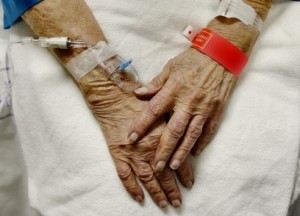
So in the case of care of older adults, we have to fight the same battle for hearts and minds. We know that a large number of hospitalizations of older people lead to a loss of function not related to the original problem. People hospitalized for any number of reasons can become incontinent, de-conditioned, and/or delirious. It is all too easy to say that these patients are sick and old and not question how many of these adverse outcomes are preventable. I believe that if we could see these events as systemic errors, then we could help generate the needed motivation to change our care processes accordingly.
We already have a number of these processes or models at our disposal. Many years ago, the Foundation sponsored a series of grants that led to the development of the Acute Care for Elders (ACE) unit, which attempts through special training and physical redesign to prevent adverse effects of hospitalization. Summa Health's ACE implementation manual is still selling.
Building on this experience, the Foundation supported Nurses Improving the Care of Hospitalized Elders (NICHE) as a nurse-driven way to spread quality improvements in hospitals around elder care. After many years of development under the direction of Dr. Terry Fulmer and Mathey Mezey at NYU's College of Nursing, the project is now directed by Dr. Elizabeth Capezuti and has received a major $5,000,000 capacity building grant from The Atlantic Philanthropies.
If we think system, not patient (or even clinician) failure, then these systemic, evidence-based approaches start to look like viable, common-sense solutions. We can do it.
For more information about IHI, go to: www.ihi.org/ihi
To learn more about NICHE, go to: www.nicheprogram.org