Before starting my internship with the John A. Hartford Foundation, the notion of improving health outcomes while decreasing costs appeared implausible. Securing strong patient-centered care for a loved one had to come at an extra expense—a large price tag for both the individual, his family, and the institution administering the care. After all, my family recently hired a home health aide to assist and advocate for my grandfather during his stay in the hospital and then during hospice, what is supposed to be one of the most patient-centered forms of care. My family believed that a consistent, if costly, presence and support system would serve him well during employee shifts and other downtime between caregivers.
And it made a difference. Our aide, Abdulai (last name withheld), served as my family’s lifeline, the person my grandfather could rely on for personalized and direct care, the person my mother could trust in clarifying medications and complicated procedures.
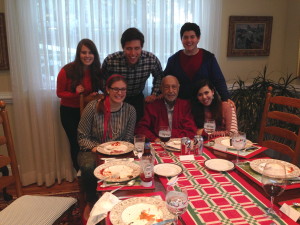 Author Caitlin Brookner (back, left) with her cousins and grandfather, Leonard Weisberg.
There will always be a role for a compassionate, hands-on caregiver like Abdulai, but ensuring that the health care system delivers quality care shouldn’t be so hard or expensive. For over 30 years, the Hartford Foundation has worked to restructure how care is delivered to older patients and support the development and dissemination of new, targeted models of care. Through programs like Project IMPACT—a primary care model that significantly improves depression treatment—and the Care Transitions Intervention—a proven, cost-effective way to reduce unnecessary hospital readmissions—the Foundation has demonstrated that generating sustainable health improvements can reduce long-term costs.
These kinds of innovations are critical. By 2030, one in every five Americans will be age 65 and older, and each day 10,000 people reach that milestone. Older adults represent some 50 percent of hospital occupancy, a percentage only predicted to rise over the near term. There is an increasingly urgent need to streamline care delivery and transform the financial health care system. Better chronic care must be achieved at a lower cost.
Many are fearful of the growing cost of aging and the fact that fewer working people will be supporting an aging population. But there are ample opportunities to realize dramatic improvements in quality of care, while reducing costs at the same time. Changing practices across the continuum of care may seem like a daunting task, but I believe the long-term health, emotional, and financial benefits will ultimately outweigh the initial costs.
Through the experience of my ailing grandfather and now my internship at the Hartford Foundation, I have begun to understand the intersection between going through the health care system and having the ability to influence lasting change. I hope others will support the Hartford Foundation and allow its pragmatic grantees to guide future innovations. For nine weeks, I was fortunate to work alongside people who truly live and breathe the Hartford Foundation’s mission. I look forward to watching this important work move ahead in the months and years ahead.