Merriam-Webster defines “beacon” as “a source of light or inspiration.” The aptly named Beacon Communities project, launched in 2010 by The Office of the National Coordinator for Health Information Technology (ONC) , showcases 17 communities as beacons of health care improvement. These 17 consortia of nonprofit organizations, health care systems, and government entities were chosen for their higher than average rates of adoption of electronic records and health information technology (IT) infrastructure. The ONC awarded each community a 36-month, $12-16 million grant to implement a plan to improve and expand their local health IT architecture, increase the ability of their local systems and information exchanges to work together to provide better health care, and thereby achieve measurable improvements in health care quality, safety, efficiency, and population health.
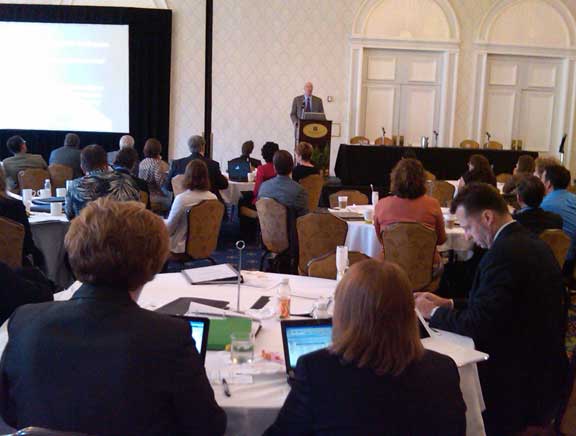
In mid-October, representatives from each of these Beacon Communities met in New Orleans for a conference co-sponsored by The John A. Hartford Foundation and the Gordon and Betty Moore Foundation and hosted by the Louisiana Public Health Institute, a Beacon Community. We were pleased to support this conference designed around the theme of “clinical transformation” and improving population health outcomes in each of the communities. In addition to allowing the participants to share their own expertise in chronic disease management and systems reform, we were able to bring leading national experts to assist the communities in thinking about care transitions, primary care redesign, risk stratification and other important concepts. Speakers included the following experts on system re-design to improve health outcomes of complex older adults:
- Eric Coleman, MD, MPH, of the University of Colorado at Denver, creator of the Care Transitions Intervention, developed with funding from the John A. Hartford Foundation.
- David Dorr, MD, MS, of Oregon Health and Science University, Principal Investigator of Care Management Plus, developed with funding from the John A. Hartford Foundation.
- Cherie Brunker, MD, of Intermountain Healthcare in Salt Lake City, Utah, co-Principal Investigator of Care Management Plus.
- Michael Malone, MD, Medical Director of Seniors Services at the Milwaukee, Wisconsin-based Aurora Health Care, inventor of the ACE Tracker methodology.
In plenary sessions and small group workshops, the Beacon Community representatives seized on the ideas presented by the speakers about how to “move the needle” on health outcomes through use of their advanced health IT systems, particularly by focusing on older adults. Several Beacon representatives I saw became very excited about the idea of using technology like Dr. Malone’s ACE Tracker system to identify in real-time the most vulnerable older adults in a hospital, who could then benefit from a “low-tech” intervention like Dr. Coleman’s Care Transitions model. The Beacons face a daunting challenge to measurably improve the health of their populations in short time frames, and they were eager to hear about these kinds of targeted, cost-saving and quality-improving measures.
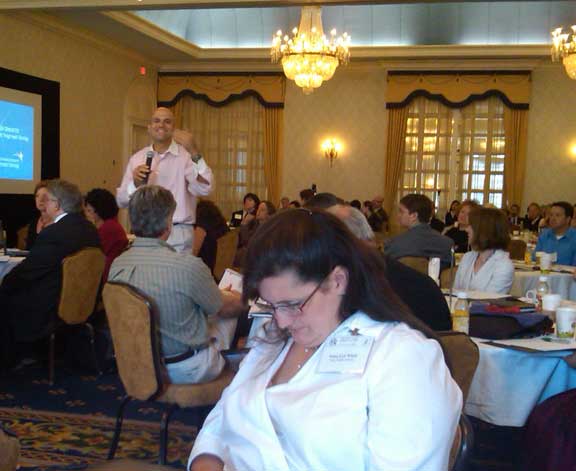
Conference attendees enjoyed presentations from ONC representatives, as well. The dynamic Farzad Mostashari, MD, ScM, the ONC’s Senior Advisor for Policy and Programs, set the stage for action and outcomes with an inspiring talk on public health efforts that have succeeded in improving health outcomes. As the former Assistant Commissioner for the New York City Department of Health and Mental Hygiene, Dr. Mostashari impressed upon the Beacon Communities the importance of coupling health information technology with successful public health approaches in order to improve population health. He challenged the participants to “keep focus amongst the swirling chaos” and to be rigorous about pushing to achieve the largest possible impact. To conclude, Aaron McKethan, PhD, who directs the Beacon Communities Program for the U.S. Department of Health and Human Services, summed up why the Beacon Communities program fits in so well with the Hartford Foundation’s mission to improve health care for older adults: "The effort is not about achieving better Health IT, it's about achieving better health."
Marcus Escobedo, Program Associate, contributed to this blog.