 Last year, for the third time, the Foundation engaged the Center for Effective Philanthropy to conduct a confidential, nationally normed survey of our grantees to find out how we are doing as a foundation. We strongly believe in feedback--both giving it and taking it, and making it safe to do both. Obviously, the infamous “power differential” between grantor and grantee makes it hard for us to get much, particularly negative, direct feedback, but CEP’s anonymous system facilitates the process. Moreover, while CEP surveys common-sense end results like satisfaction and impact, they also include measures that their research suggests are actionable precursors/predictors of those outcomes, like contact, clarity, and alignment.
We undertook this particular assessment with more trepidation even than usual. The elephant in the room, our financially driven rescissions and restructuring in winter 2009-2010, was very worrying. Because of our unique situation in 2008 and 2009, we had been forced to do some unpleasant things--such as reducing funding to existing grants--and we were still in the first year of a difficult change process with our 28 Centers of Excellence in Training in Geriatric Medicine and Psychiatry. Both of these factors gave us real pause, but we decided it was better to know and take action than just stick our heads in the sand and mistake hope for a plan.
So how did we do? The final report can be found here, and we would very much value any thoughts or interpretations that anyone might want to offer. Our anonymous contact system is available at http://www.jhartfound.org/grantee_feedback.htm, or you can comment on the blog (overtly or covertly) here.
There is a lot of information in the 100+ page report and, in truth, we are still digesting six months after we received the final version. But our take is pretty much, “There’s some good news and there’s some bad news.” I will reverse my usual preference and consider the good first.
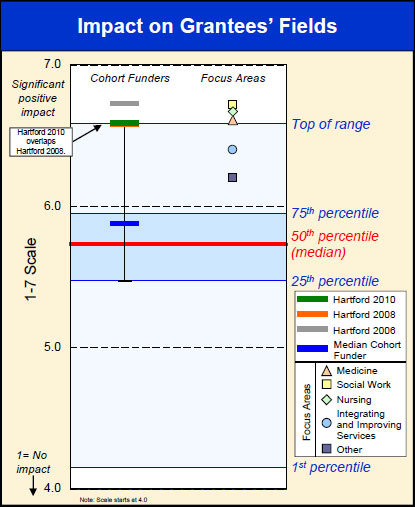 We are very gratified by the very high scores (compared to other foundations) that show we are having an impact on the field. Given that our grantees are all experts in aging and health and deeply committed to the cause, not just their individual projects, this is a great compliment. We are also very reassured that the custom question we use, “The Foundation is on the right track to improve the health of aging populations,” shows that our expert grantees think we are still heading in the right direction.
Now the bad news. We are very concerned about our low grantee satisfaction ratings. While everyone wants to be liked, we think this is a particular concern because having a real partnership with our grantees is essential to continuing progress towards our mission of improving the health of older Americans. We know that we don’t have all the answers, and we know that the money we bring only makes things possible. Without empowered leadership from grantees (and non-grantees), our money can at best buy disconnected activities, not our real desire, change.
Perhaps the most clearly actionable precursors of our low satisfaction ratings (at the 25th percentile) are suggested by our ratings on understanding of grantee goals and strategies (also very low) and ratings of our communications with grantees (just average). These are areas we can improve.
We are also very frustrated by our continuing low scores for provision of “comprehensive assistance.” This is a concept developed by CEP through its research on what foundations can do “more than the money” that meaningfully helps grantees. CEP’s research suggests that piecemeal and scattershot efforts are not effective. The high standard that CEP proposes as comprehensive support is providing at least seven kinds of support: e.g., communications, fundraising, networking, strategic advice.
We thought that we were providing this kind of support, at least in many cases. Our communications firm, Strategic Communications and Planning, stands ready to assist grantees, we have supported convening and coalitions among grantees, we spend a great deal of time brokering connections and trying to find other sources of support, and so on. But perhaps we are just not meeting grantee needs with our offerings. It is also certainly the case that there is a big difference between providing assistance and winning a desired outcome.
So, what are we going to do?
First, we can structure our communications and ensure that we have personal communications and a sound relationship with every grantee. While in-person communication is certainly essential, we also hope that a new website we are currently developing will facilitate bi-directional communication through a social media component and a more interactive and open design.
Second, we will make a purposeful effort to learn the strategies and goals of grantees to enable us to work in a more equal partnership. We need to clearly acknowledge that the people and organizations with whom we work have an existence outside of being a “grantee.” “Grantee” only captures a small aspect of anyone’s reality, just as “patient” or “resident” is only a small part of the lives of people. We don’t expect to always have perfect alignment of goals and strategies with the people and organizations we fund, but by being more aware we believe that we will be able to build stronger and more effective partnerships.
Third, we are not giving up on comprehensive assistance. We will go back to the drawing board and find out what grantees think would be valuable. We will try to create mechanisms that will then meet these needs, and we will track how we are doing in this critical domain. And if that doesn’t work, we will try again until we get it right.
We are in this and with you for the long haul.