One of our challenges is getting to the heart of geriatrics--what is expert geriatric care like, and why would you want it for yourself or loved ones? A previous post drew on a description of the geriatric care delivered at the University of Alabama at Birmingham (UAB) and helped me extract principles that make expert geriatric care special: It is integrated, patient centered, sensitive, capable of balancing complex issues, interdisciplinary, and proactive/preventative.
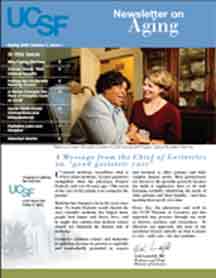 I was equally impressed by UCSF’s “Newsletter on Aging” from this spring. The stories they relate show how many disciplines, including nurses, social workers, psychologists, and physicians, work together to provide outstanding care to older adults in San Francisco. They adhere to principles similar to UAB’s. As Seth Landefeld, the division chief, puts it, “Geriatrics combines science and humanity in medicine, because its practice is explicitly and unabashedly grounded in respect and devotion to older patients and their complex human needs.”
I was particularly moved by the newsletter’s vignettes, which illustrated UCSF’s commitment to patient-centered care. For example, Dr. Jennifer Morris goes the extra mile in caring for challenging older veterans in the section “Why Caring Matters.” To help convince one patient take more control of his diet she begins cooking dinner with him and another veteran in their assisted living facility. For another very troubled patient, she intervenes with a social service agency and advocates for better care. She states, “I firmly believe that everyone is good--I am fairly naïve that way--and while my approach doesn’t always work, when it does it’s because patients learn that I am here for them, not just their diabetes or end-stage disease.”
Reading these descriptions of UCSF’s work led me to not only recognize the similarities between their approach and UAB’s, but also to gain a deeper understanding of what geriatrics is all about:
The heart of geriatrics is heart.