 Last week, several events coincided giving me hope that the fight against Alzheimer’s disease has entered a new round. While we might not see a knockout immediately, a new national plan and the work of committed champions, including Hartford partners and grantees, gives me renewed optimism that the fight can be won.
One in eight Americans over the age of 65 and nearly half of those over 85 have the terribly debilitating and deadly Alzheimer’s disease. Of course, the pain and suffering accompanying the loss of cherished memories and the sense of self not only affects the 5 million people with Alzheimer’s, but devastates additional millions of family members and caregivers. The disease also bears enormous financial costs, with an estimated $200 billion spent on care this year alone. With the population of older adults booming, so will the number of Alzheimer’s diagnoses, the financial costs, and the agony and loss faced by far too many families.
In recognition of this looming epidemic, the Secretary of the U.S. Department of Health and Human Services released an ambitious national plan last week to tackle Alzheimer’s. Authorized as part of 2011 legislation, the new plan for the nation (not just the federal government), has a primary goal of developing effective ways to prevent and treat Alzheimer’s by 2025.
The plan was announced during the 2012 Alzheimer’s Disease Research Summit, organized by our partners at the National Institute on Aging (NIA). New federal investments of $156 million were announced, although much of that resides in the president’s proposed FY2013 budget.
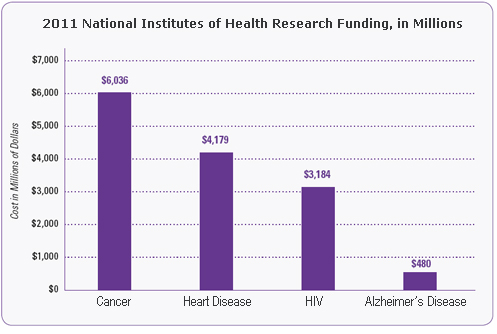 Raising federal investments in Alzheimer’s makes up an important part of the national plan. Advocates like the Alzheimer’s Association have been calling for more research funding, given that the disease is the only top-10 cause of death lacking a way to prevent, cure, or even slow its progression. Fortunately, $50 million in immediate funding is going in part toward two large treatment and prevention trials. You may have seen headlines for one of these potentially groundbreaking trials last week.
Another portion of this $50 million is supporting people with Alzheimer’s through public education, like in this new Web site for caregivers, and through the training of health professionals. The latter includes $2 million in grants recently awarded to HRSA’s Geriatric Education Centers —many led by or involving Hartford grantees—to provide high-quality training to doctors, nurses, and other providers on recognizing the signs of Alzheimer’s and helping patients manage the disease. This is essential and I hope the investment grows, especially given the GECs' overall woeful underfunding and recent budget cuts. Even with the promise of preventive drugs or other treatments, heart disease and diabetes have taught us how hard it is to manage tough conditions and their accompanying co-morbidities. While I hope we find effective treatments in the very near future, we still need to be able to deliver high-quality care to patients who already have Alzheimer’s and other forms of dementia.
However, early detection and prevention do seem to hold some of the greatest hope for combating Alzheimer’s. This was a key message delivered by recipients of the MetLife Foundation’s 2012 Awards for Medical Research, another important event held last week that gives me hope for the future. People can have Alzheimer's for 15-20 years before showing symptoms, and researchers see this as a window of opportunity in which to prevent or reduce debilitating symptoms.
One of the researchers delivering this message was Dr. Randall Bateman, who received MetLife’s Promising Investigator Award. Dr. Bateman was supported early on by the Hartford Foundation with a Beeson Scholar junior faculty award. Several other past Beesons, including Drs. David Holtzman and Eddie Koo, have also received MetLife awards. They are joined by at least 20 other former and current Beeson Scholars working in the Alzheimer’s arena, from basic science to better care delivery.
The MetLife Foundation awards were managed this year for the first time by the American Federation for Aging Research (AFAR), which through our grant funding administers the Beeson program in partnership with the National Institute on Aging. These partnerships have helped build the field of experts who are leading the fight against Alzheimer’s. These Beeson Scholars, MetLife Foundation awardees, AFAR, the NIA, and others now have a national plan, increased federal investments, and hopefully new energy and drive to continue on to the next round in the fight against this terrible disease.