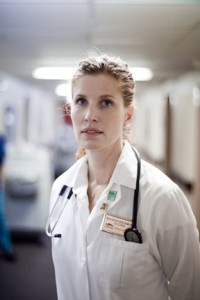
 Allow me to introduce you to Melissa Aselage, MSN, RN. Melissa is a Building Academic Geriatric Nursing Capacity (BAGNC) Initiative Pre-doctoral Scholar at the Medical University of South Carolina College of Nursing, where she studies techniques to help nursing home staff manage meal time behaviors in residents with dementia. Melissa is also a full-time lecturer at the University of North Carolina, Wilmington School of Nursing, where she educates nursing students to care for older adults.
As a student, Melissa, like most of her peers, had no interest in geriatrics. Back then, she thought, “I don’t want to work with older adults and I’ll never work in a nursing home.” Yet, after graduation, Melissa found herself working in a nursing home. She realized, “If you don’t make the commitment to stay and to make a difference and change it, then it doesn’t ever get any better . . . I wanted to make a difference at a national and international level to improve the quality of care we are delivering in the nursing home setting for our older adults.”
Today, Melissa is conducting her dementia research in nursing homes and using her influence as a role model to inspire nursing students. “If I can influence any of them to go into geriatric nursing, then I feel I have done a good job,” she says.
Take a listen.
Building Academic Geriatric Nursing Capacity from Don Battershall on Vimeo.
 Melissa is one of 18 BAGNC champions (scholars, fellows, alumni, mentors, Hartford Center of Geriatric Nursing Excellence directors) who were featured in our most recent annual report, “A Day in the Life of an Academic Geriatric Nurse.”
For several years, the Foundation has focused its annual reports on one program in our funded areas of medicine, nursing, social work or our service projects. In 2010, we focused on our nursing portfolio because its largest program--the Building Academic Geriatric Nursing Capacity (BAGNC) Initiative--is celebrating its 10th anniversary. In fact, we dedicated a blog series in 2010 to mark this event and produced an evaluation report to document the success of 10 years of investment.
This time around we elected to do business differently. We shied away from a text-heavy annual report and instead modeled this report after a “Day in the Life” series, employing a photo-driven format to celebrate the richness and diversity of a career in academic geriatric nursing.
We did so by taking photographs during a day at work to illustrate the impact these 18 geriatric nurses have on education, research, practice, and policy to benefit the health of older adults. We believe that this annual report—with its focus on photographs—allows readers to quickly and clearly see the impact of the John A. Hartford Foundation’s investment in geriatric nursing on the health of our aging society.
We hope these photos will serve as a recruitment tool to inspire future generations of nursing students to work with older adults, as well as educate and inform health care professionals, the media, policymakers, potential funding partners, and the public about the need for and rewards of academic geriatric nursing.
As Melissa notes in the video, “No matter where you go, you will be a geriatric nurse.”
Stay tuned for our upcoming BAGNC Annual Report blog series with four interviews and photos of other influential BAGNC leaders.
This is the first in a series of blogs celebrating the release of our 2010 Annual Report, “A Day in the Life of an Academic Geriatric Nurse.” Links to the series are below: