Hats off to Risa Lavizzo-Mourey, MD, MBA, President and CEO of the Robert Wood Johnson Foundation (RWJ), on her recent call to action for nurses to take a seat at the health care reform table. In numerous polls, the public ranks nurses as among the most trusted professionals. Yet in a 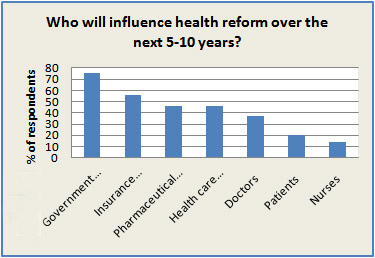 recent poll conducted by Gallup, RWJ found that opinion leaders rank nurses seventh among stakeholders in terms of influence in health care reform. Only 14 percent said that nurses have a great deal of influence over health reform, ranking nurses behind government officials; insurance, pharmaceutical, and health care executives; physicians; and patients.
There are many barriers to nurses gaining influence. One of the most frustrating is the perception that nurses are not important decision makers or revenue generators simply because they don’t directly bill or order procedures. If we are going to have high quality and cost effective care, nurses need to be part of the reform conversation. As we know from modern quality improvement science, important ideas must come from the “front lines”—and nurses are there every day.
Change must happen by engaging the right nurses--a broad base of informed stakeholders. Essential to this mix are gerontological nurses, whose skills and research reflect the needs of the overwhelming majority of patients they serve. These nurses can competently care for our aging society and anticipate its unique health care needs. Given the demographics and the rising costs of health care services for older Americans, this is vital to successful reform.
Thankfully, since the Institute of Medicine’s Retooling for an Aging America report publicized our nation’s shortage of geriatrics-trained health workers, many people and organizations have been working hard to promote geriatric nursing in the policy area. For a summary of current policy initiatives related to caring for an aging population, see a recent article by Susan Crocker Houde, PhD, ANP-BC, and Karen Devereaux Melillo, PhD, ANP-BC, in the December 2009 issue of the Journal of Gerontological Nursing.
We hope that articles like this—as well as Dr. Lavizzo-Mourey‘s column--will encourage nurses to step up to the policy table and do more to improve health care in this country.