Health Affairs Publishes Three Age-Friendly Papers in October Issue
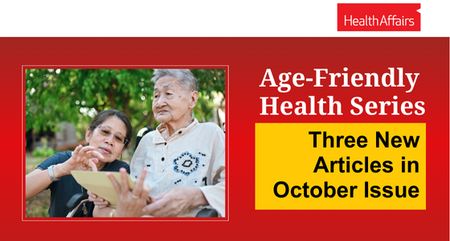
Health Affairs has published three papers in October as part of its Age-Friendly Health series. One paper looks at the disproportionate burden of Alzheimer's on Latino communities, another conducted a descriptive analysis of the Institutional Special Needs Plans market and the third addresses the problems with Medicaid home and community-based services.
The Age-Friendly Health series aims to inform health policies and covers new issues related to building more equitable, high-quality health systems for older adults.
ENTRY POINT: The Disproportionate Burden Of Alzheimer’s On Latino Communities by Heidi de Marco
The author looks at Latino patients with dementia, which face a complex web of challenges, from serious comorbidities to delayed diagnoses to fragmented care. Experts point to the effects of social determinants of health such as low socioeconomic status and chronic health conditions as contributing factors to increased risk of dementia among Latinos. Latinos are more likely to face missed or delayed diagnosis which can have significant consequences. Culturally sensitive outreach and more representation in research is needed to address the challenges in Latino communities. The paper is also published in Spanish.
RESEARCH ARTICLE: Institutional Special Needs Plans In Nursing Homes: Substantial Enrollment Growth But Low Availability, 2006–21 by Amanda C. Chen, Joseph G. P. Hnath, David C. Grabowski
The authors conduct a descriptive analysis of Institutional Special Needs Plans, which are designed for long-term residents of nursing homes or those who live in the community but need a nursing home level of care. Since the introduction of these plans, availability of and enrollment in these plans have grown dramatically. Despite this growth, nearly 70% of nursing homes did not have residents enrolled in 2021 and in more than 60% of U.S. counties, there were no plans available. Increased understanding of these plans could inform policies to address long-standing concerns about the quality of care in nursing homes.
COMMENTARY: Addressing Problems With Medicaid Home And Community-Based Services In The Age Of Rebalancing by Katherine Rohde, Norma B. Coe, Pilar Gonalons-Pons, Katherine Miller, Amanda R. Kreider, Allison K. Hoffman
The researchers describe the legal authorities that Congress created from among which states may select to provide Medicaid beneficiaries with long-term services and supports in home and community-based settings, instead of institutions. The complicated maze of federal legal authorities has resulted in inconsistent and inequitable access to care. The authors propose a simpler architecture to these authorities which would better serve program goals.
Visit the Health Affairs Age-Friendly Health series.
Learn more about JAHF's co-support of Health Affairs.