Home Centered Care Institute Article Series: The Transformative Impact of House Calls
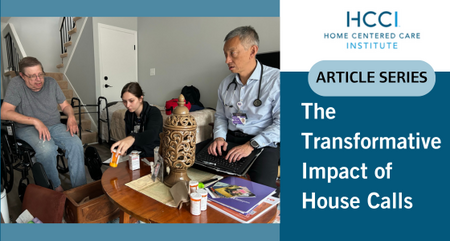
The Home Centered Care Institute (HCCI) has released parts I, II, III, IV and V of their article series on "The Transformative Impact of House Calls."
In the article series, HCCI Development Associate Blair Findlay shares her shadowing experience of a day of house calls.
In part I, Blair details how Dr. Chiang and medical assistant, Nicole, work together to better understand their patients' daily lives and provide personal, compassionate care. She describes how house calls allow patients to be treated as the whole person and the personal impact of the patient's experience. Blair describes how home-based primary care breaks down barriers to care for those who need it most and is a "beacon of compassionate and tailored medical care that transcends a traditional healthcare setting."
In part II, Blair shares her experiences and insights from that day. She talks about hospice care and the visible difference home-based primary care makes. She talks about how vital it is that those who need it know it’s available to them and how to access it.
In part III, Blair reiterates how meeting patients in their homes allows house call providers to see the whole patient—not just the parts they show in the office. Though translators are available, cultural factors and tradition come into play during house visits, which wouldn't be obvious in a traditional office setting. This allows providers the opportunity to better care for patients during house visits.
In part IV, Blair attends the fourth house call of the day with Fazli and Ilma and their daughter, Ateef.* (*Names have been changed for privacy.) Ateef had to take off work to attend the visit as she acts as her parents’ primary caretaker. As we left their house, Dr. Chiang asked me, “What do you think is one of the main reasons patients go into nursing homes?” His answer was “a lack of daughters,” spotlighting the fact that the unpaid and laborious job of caring for ailing parents is often placed on a daughter’s shoulders.
In part V, Blair does her final house call where she is reminded of how important it is for doctors to visit patients in their homes. Dr. Chiang visited Gary* (*names have been changed for privacy) who broke both his leg, leaving him homebound. To add to his condition, Gary is dealing with depression and high blood pressure. Without house calls, Gary's son would have to take off work to take his father to his appointments. Another benefit to house calls is that Dr. Chiang gets an insight on how the patient is living that he wouldn't otherwise in his office, such as the types of food being eaten or activities taking place, whether against doctor's recommendations or not.
Read part I.
Read part II.
Read part III.
Read part IV.
Read part V.
Go to the HCCI article series.
Learn more about HCCI.
Learn more about JAHF's co-support of HCCI.