
One of the peculiar things about health care in the U.S. is that when you’re receiving care, it’s as though we live in a world where money doesn’t exist. This is as it should be, as clinical staff, doctors, nurses, and many others prize human life above profit. But as usual, the reality versus the ideal is far more complicated. After care has been provided, then money matters a great deal, determining what will be paid for, and who is financially responsible. There was $4.5 trillion spent in 2022 for healthcare in the U.S. according to the Centers for Medicare & Medicaid Services. Because of this, large swaths of entire professions not directly involved in care delivery get involved, hospital and health plans administrators, health policy researchers, and lawyers.
Which brings us to Medicare and “observation status,” a designation used by clinical staff at hospitals that means little to the average person, unless a chain of events puts you on the wrong end of it, and then suddenly you, a parent, a family member, or someone close to you is getting a potentially exorbitant bill over which you have no control. As part of an internship in law school, I did a weekly shift on the National Helpline at the Medicare Rights Center, a non-profit that helps people navigate their Medicare coverage. One of the first calls I received was from a man whose spouse had been in the hospital on observation status, moved to a skilled nursing facility for rehabilitation, and upon discharge, was presented with a bill for $16,000.
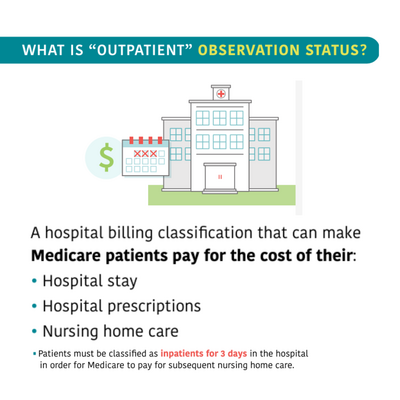
Because Medicare has extensive rules and regulations about when someone can be admitted to the hospital, observation status was created as a “halfway point,” as one health researcher put it, between emergency rooms and being admitted to the hospital. Observation status in Medicare is for beneficiaries who genuinely need care, but hospitals know that they do not meet the guidelines set by payers, including Medicare, for inpatient hospital admission. Today, many hospitals have departments that oversee people on observation status. Since Medicare beneficiaries who are on observation status are considered outpatients, it has significant financial consequences for them, because outpatient services are subject to 20% co-insurance. Perhaps more significantly, being in the hospital on observation status does not satisfy another Medicare rule, that a beneficiary needs to have been formally admitted to the hospital as an inpatient for three consecutive days for Medicare to pay for post-hospital skilled nursing facility care. (This requirement has been waived for private health plans within Medicare that pay for care, although that, too, is changing.)
In general, if a Medicare beneficiary was on hospital observation status and transferred to a skilled nursing facility, which Medicare then refused to cover, he or she has had no recourse. This was exactly the reason why the man I spoke with on the Medicare Rights Center’s National Helpline received the $16,000 nursing home bill. Having no recourse to unilateral government action usually doesn’t sit well with most Americans. In response, two non-profit legal organizations, the Center for Medicare Advocacy and Justice in Aging, and a law firm working pro-bono, Wilson Sonsini Goodrich & Rosati, sued Medicare in 2011 in federal court. The Court ruled that a sub-group of Medicare beneficiaries on observation status should receive appeal rights – those who were initially admitted to the hospital as inpatients but later changed to observation status. Still, the government tried to fight this decision, and lost on appeal in 2022.
As a result of the lawsuit and the Court’s decisions, Medicare has proposed a new rule to give appeal rights to the Court-designated class of Medicare beneficiaries. But because money is involved, the proposed rule is 105 pages long with numerous references to statutes and federal regulations. For the government to receive feedback from the public on its proposed rule, an open comment period ran through February 26, 2024. While lawyers, hospital administrators, health plans, various healthcare industry groups, and non-profit organizations focused on health, aging, and disability no doubt read the proposed rule very closely, I doubt that many average citizens did.
The easiest thing would be to do away with observation status altogether, or at least count all days in the hospital towards the required 3-day prior hospital stay requirement for nursing home Medicare coverage. That is what a bipartisan group of Representatives introduced a bill to do last summer. But until then, we’ll have to wait and see how Medicare implements its new appeal rule as the latest development within American health care that navigates the constant tension between the need for care on the one hand with highly technical knowledge that is required to distribute large sums of public money to pay for care on the other hand.
This article was originally published 3/7/24 on LinkedIn by senior program officer Scott Bane.