Journal of Palliative Care Article: Top 10 Tips Palliative Care Clinicians Should Know About Messaging for the Public
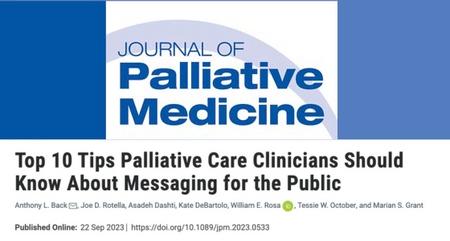
JAHF grantees have published an article in the Journal of Palliative Medicine, "Top 10 Tips Palliative Care Clinicians Should Know About Messaging for the Public."
Research demonstrates that the lay public often has inaccurate assumptions about palliative care that can lead people with serious illnesses to decline palliative care services. Evidence-based messaging can help clinicians engage more effectively with the public to promote the benefits of palliative care.
The ten tips provided are based on a multiyear and multiorganizational project focused on improving the messaging of palliative care for the public. Incorporating public-informed messaging strategies could enable palliative care clinicians and advocates to address the lay public with greater confidence and clarity about how palliative care can serve them, their families and their communities. The authors identified these top 10 tips:
- Tip 1: Remember that public messaging is about introducing the public to a kind of specialized medical care; do not assume the public knows anything about palliative care.
- Tip 2: Define your intended audience and craft your message specifically around what is important to them, beware of a message that is about what is important to you.
- Tip 3: Be sure to emphasize the benefits of palliative care (because the public does not know them) rather than its features, do not define palliative care based on its differences from hospice.
- Tip 4: Use pictures that are aspirational for your intended audience that depict living well with a serious illness—avoid ‘‘dying hands’’ and visual euphemisms for dying.
- Tip 5: Frame palliative care as living well with a serious illness, confronting people with dying as an introduction attracts only a small segment of the public.
- Tip 6: Tell stories that illustrate what happens when palliative care is done well, do not rely on statistics.
- Tip 7: Anchor your message in facts and truths, instead of trying to debunk myths, lead with a truth you want your audience to retain.
- Tip 8: Deliver your message with voices and characters that represent diverse communities within your intended audience and know what is important to them.
- Tip 9: Ensure that your language is simple and conversational, beware of medical terms, clinical jargon, and even process improvement terms.
- Tip 10: When developing and evaluating your messaging efforts, sample people from your intended audience; do not use family, friends, or colleagues.
Go to the article abstract.
Go to the Serious Illness Messaging Toolkit.
Learn more about JAHF's co-support of the University of Washington and a coalition of national serious illness care organizations.