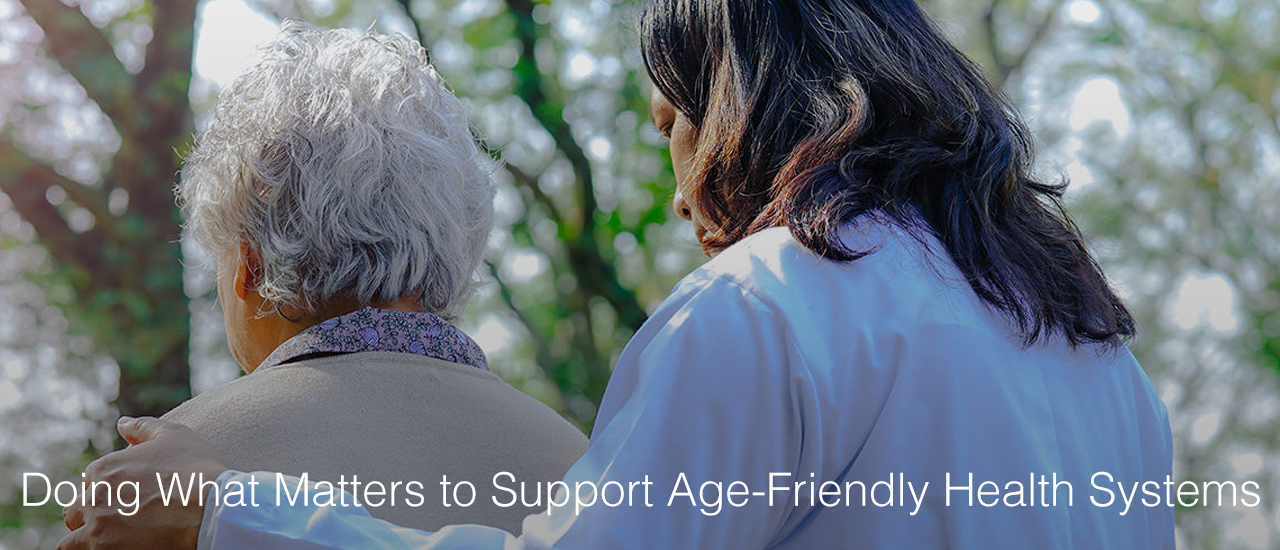


Age-Friendly Health Systems
The COVID-19 crisis has underscored why it’s important to bring age-friendly health care to 1,000 hospitals and practices by the end of 2020.
The evidence and ingenuity to deliver care that achieves better outcomes for older adults exists, but there is a gap between what works and what is done in practice. As more health systems join the Age-Friendly Health Systems movement, more older adults are receiving evidence-based care that reduces harm from health care and focuses on what matters to older adults and their families. In times of crisis, age-friendly care is more important than ever.
In 2016, we set a bold vision to ensure age-friendly care reaches as many older adults as possible—and quickly. Today, working with our partners at the Institute for Healthcare Improvement, the American Hospital Association, and the Catholic Health Association of the United States, we are helping health systems deliver the “4Ms”—evidence-based best practices to:
- Know and align care with What Matters to older adults;
- Ensure Medication, if necessary, does not interfere with what matters to the patient, their mobility, or their mentation;
- Focus on Mentation by preventing, identifying, treating, and managing dementia, depression, and delirium across all settings of care; and
- Prioritize Mobility, ensuring older adults move safely every day.
- Nearly 400 health care teams participated in the Age-Friendly Health Systems initiative as of December 2019, with 265 sites gaining official recognition.
- Needed resources have been developed to implement and make the case for age-friendly care:
- The Business Case for Becoming an Age-Friendly Health System, which includes return-on-investment calculators for inpatient and outpatient settings;
- “What Matters to Older Adults?” toolkit; and
- Age-Friendly Health Systems EHR Implementation Guides (for Cerner and Epic).
Read more about the Age-Friendly Health Systems initiative.
Geriatric Surgery Verification Program
We’ve helped develop new standards for surgery that are innovating and improving the quality of care for older adults.
Forty percent of all patients undergoing surgery are over age 65, and rates of death and complications increase with age. Between 15 and 50 percent of older surgical patients develop delirium, a dangerous and deadly altered mental state. Hospitals and health systems must continuously optimize surgical care for older patients.
We worked with the American College of Surgeons to create the Geriatric Surgery Verification Program, a quality improvement initiative built on a set of interdisciplinary standards developed through a unique collaboration of more than 50 organizations representing older patients and families, advocates, regulators, health care professionals, and multiple medical and surgical specialties.
- The initiative released a set of 30 new surgical standards that prioritize identifying and acting on what matters to older patients. The standards can be achieved by all hospitals regardless of size, location, or population served.
- In vetting the standards at eight hospitals, we found:
- More patients go home rather than needing a stay in a nursing home or other care facility; and
- According to one of the testing sites, one in four patients changed their original surgical plan after a team review.
- The Geriatric Surgery Verification program was launched in October 2019, when it began accepting applications from hospitals ready to demonstrate their commitment to improving the quality of care for their older surgical patients.
Read more about the Geriatric Surgery Verification Program.
Home-Based Primary Care
We’re improving health and curbing costs by bringing primary care services to the home, where older adults want to be.
More than two million older adults are homebound because of frailty and complex conditions. They often need primary care the most, yet are least likely to get it and, consequently, are more likely to end up in emergency rooms. Sudden changes in health care delivery—as in the case of the COVID-19 pandemic—require immediate changes, such as the move to home-based care and telehealth.
We supported three coordinated projects to increase access to high-quality, home-based primary care for older adults with complex needs:
- The American Academy of Home Care Medicine is developing a centralized, comprehensive directory of home-based primary care practices.
- The Home Centered Care Institute is scaling up the training of clinicians.
- The National Home-Based Primary Care Learning Network is expanding and enhancing their National Learning Network for home-based primary care providers.
We started funding home-based care projects more than 20 years ago, building a robust knowledge base about how to provide high-quality, home-based primary care. As a result:
- Independence at Home, a primary care demonstration project involving 10,000 people funded by the Centers for Medicare & Medicaid Services (CMS), has confirmed that home-based primary care increases quality while decreasing costs. The project:
- Saved more than $49 million in its first three years;
- Reduced unnecessary hospitalizations; and
- Showed how providers can even provide x-rays, EKGs, and other tests in the home, rather than needing to schedule in-office follow-up appointments.
- The success and efficacy of Independence at Home has led CMS to include home-based primary care in new payment models it released in 2019 around primary care.
Watch this video from the American Academy of Home Care Medicine about the power of home-based primary care.