ACS NSQIP Geriatric Surgery Pilot Study May Help Improve Outcomes for Older Surgical Patients
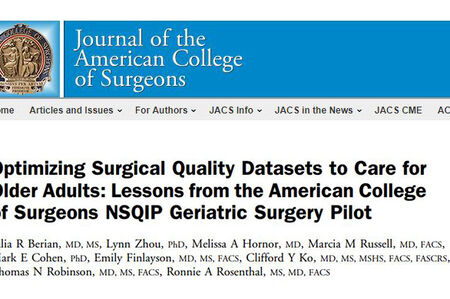
The American College of Surgeons (ACS) National Surgical Quality Improvement Program (NSQIP) Geriatric Surgery Pilot Study findings have been released.
The "Optimizing Surgical Quality Datasets to Care for Older Adults: Lessons from the American College of Surgeons NSQIP Geriatric Surgery Pilot" paper was published by the Journal of the American College of Surgeons.
The ACS NSQIP Geriatric Surgery Pilot, launched in 2014, has collected risk factors and outcomes on patients 65 and older in four new categories - cognition, decision making, function, and mobility. The researchers found that geriatric-specific risk factors are important for patient-centered care. “A successful outcome in surgery is not just that a patient didn’t die or have a heart attack. To older adults, a successful outcome often has more to do with their cognition and their daily function, rather than the absence of a morbidity or mortality event 30 days after an operation,” said lead author, Julia Berian, MD, MS.
Surgical quality datasets can be better tailored toward older adults and they could significantly improve the ability of surgeons to predict poor outcomes in older surgical patients. The NSQIP Geriatric Surgery Pilot is one of the building blocks for the Coalition for Quality in Geriatric Surgery project, a partnership between ACS and The John A. Hartford Foundation.
The paper details that ACS "has partnered with the American Geriatrics Society and The John A. Hartford Foundation to produce best practice guidelines for preoperative and perioperative care of older adults."
To read the paper, click here.
To go to the related JAHF grant, click here.