NASHP POLST Blog: End of Life Planning – Best Practices in POLST
The National Academy for State Health Policy (NASHP) has published a blog post, "End of Life Planning: Best Practices in POLST."
During a recent NASHP webinar, experts and state administrators spoke about the benefits of POLST as well as promising practices and lessons learned from West Virginia and Louisiana.
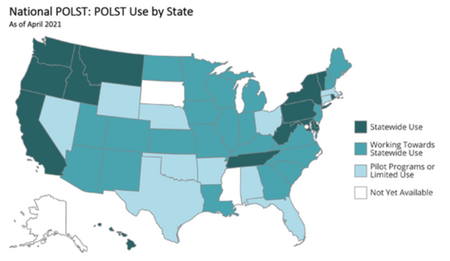
A POLST is a portable medical order that communicates treatment goals and preferences for people with serious illness or advanced frailty. The use of POLST can help to ensure that patients’ treatment preferences are respected in critical clinical situations and to avoid unwanted treatments if patients cannot speak for themselves during a medical crisis. A 2020 JAMA study found that, while many patients still received care that did not reflect their POLST order, treatment-limiting POLSTs were associated with significantly lower rates of intensive care unit (ICU) admission compared with full-treatment POLSTs.
To promote POLST, the blog post offers some useful recommendations:
- Support state POLST programs
- Consider adopting or adapting the National POLST Form
- Develop a comprehensive POLST registry
- Conduct outreach and education
- Learn from other states and get involved with National POLST
To learn more from other states about advance care planning and palliative care, NASHP hosts a Palliative Care Resource Hub—funded by a grant from The John A. Hartford Foundation—that contains a series of state policy tools and resources.
To go to the blog post, click here.
To learn more about National POLST, click here.
To see National POLST guidance on severe trauma, click here.