World Elder Abuse Awareness Day: Join Us in Building Stronger Supports for Older Adults
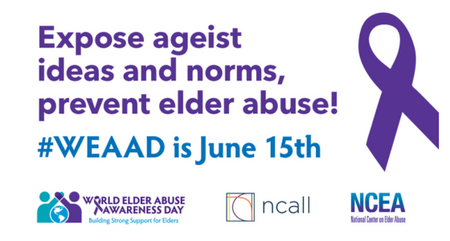
Join us and our network of grantees and colleagues on June 15 to recognize World Elder Abuse Awareness Day (WEAAD) by using the below resources.
WEAAD was launched by the International Network for the Prevention of Elder Abuse and the World Health Organization at the United Nations. The purpose of WEAAD is to provide an opportunity for communities around the world to promote a better understanding of abuse and neglect of older persons by raising awareness of the cultural, social, economic and demographic processes affecting elder abuse and neglect.
The Administration for Community Living funded the National Center on Elder Abuse (NCEA). NCEA is holding a webinar for WEAAD:
- WEAAD 2025 Webinar: Beyond the Billions: Understanding and Preventing Elder Financial Fraud, Wednesday, June 11 at 1pm - 2:15pm ET
Access resources from JAHF partners and grantees to help build strong supports for older adults that prevent elder mistreatment:
WEAAD materials:
- WEAAD Tool Kit and Action Page
NCEA resources:
- NCEA has many resources, including a publication for pre-professionals:
- What Public Health Students Need to Know about Elder Abuse
- What College Students Need to Know about Elder Abuse
- What Dental Students Need to Know about Elder Abuse
- What Health Care Students Need to Know about Elder Abuse
- What Psychology Students Need to Know about Elder Abuse
- What Social Work Students Need to Know about Elder Abuse
JAHF/Grantee/Partner Resources:
- Elder Mistreatment Emergency Department Toolkit from the National Collaboratory to Address Elder Mistreatment
- Posted on the Geriatric Emergency Department Collaborative (GEDC) website, the toolkit contains resources that train ED staff to use simple screens and action steps to address elder mistreatment.
- The National Collaboratory Mentorship Program
- Meet the clinicians, service providers, researchers, policymakers and advocates from multiple disciplines who are focusing on elder mistreatment and abuse. National Collaboratory staff talk more about the program and WEAAD here.
- The National Consumer Voice on Quality Long-Term Care Residents’ Rights Month (October)
- The Resident’s Voice Challenge encourages residents to submit essays, poems, artwork, drawings, or videos related to the theme, highlighting the importance of residents’ rights and how these rights can be carried out in all long-term care settings.
Journal articles and reports:
- Racial/Ethnic Group Differences in Older Adults’ Involvement with Adult Protective Services, Journal of Gerontological Social Work
- Leveraging VA Geriatric Emergency Department Accreditation to Improve Elder Abuse Detection in Older Veterans using a Standardized Tool, Academic Emergency Medicine
- Elder Mistreatment Prevention Rounds in Nursing Homes, American Journal of Nursing
- Need, Access, Impact, And Opportunities: Findings From A Multi-Site Evaluation Of Elder Justice Shelters In The U.S., The New York Academy of Medicine report
- Elder Mistreatment Emergency Department (EMED) Feasibility Case Study: Eastern Niagara Hospital, GEDC Case Study
- Accelerating the Pace of Elder Justice Policy to Meet the Needs of a Growing Aging Population, Journal of the American Geriatrics Society
- Supporting Older Americans’ Basic Needs: Health Care, Income, Housing, and Food, Justice in Aging Issue Brief
Videos:
- Virginia Helping Elders Access Resources (HEAR) videos on elder justice
Find out more ways to take action.
Learn more at the WEAAD website.
Go to the National Center on Elder Abuse (NCEA).
Learn more about JAHF's co-support of EDC's National Collaboratory.